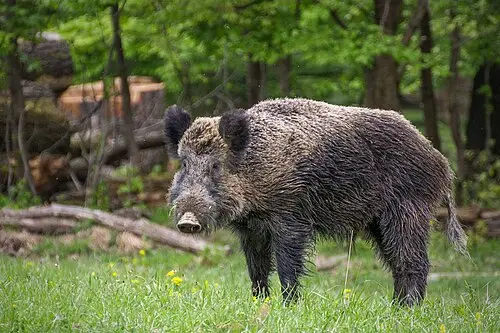
 📸 Photo
Photo: Valentin Panzirsch · CC BY-SA 3.0 at · Wikimedia Commons Source
Eurasian Wild Pig
Sus scrofa (Eurasian Wild Pig · イノシシ)
💡 Everyday Comparisons for Size, Mass & Speed
- 💡 Animal Diversity Web notes crop damage as the biggest problem farmers face from wild pigs and adds that they can carry diseases transmissible to livestock.
- 💡 Its maximum adult weight of 272 kg is about thirteen 20 kg bags of rice (Comparison).
- 💡 Its maximum body length of 2.4 m is slightly more than half the length of a passenger car (about 4.5 m) (Comparison).
Reference standards: coach bus ~12 m, mid-size car ~4.9 m, compact car ~1 t, basketball hoop 3.05 m, credit card 8.56 cm.
Site-computed relative index from recorded values; not a formal scientific metric.
📖 1. Overview
The Eurasian Wild Pig is a wild pig living on almost every continent except Antarctica, and domestic pigs belong to the same species.
🦴 2. Anatomy & Morphology
Its coat is thick and coarse, its snout is long and flat, and its upper canines often remain visible even when the mouth is closed. Piglets have stripes along their backs that fade within about 4 months.
🔍 3. Ecology & Behavior
It feeds mainly on grains, fruits, and roots, but also eats eggs, carrion, small animals, and insects. Females give birth to an average of 5–6 young per litter.
🇰🇷 4. Connection to Korea
It is a species distributed in Korea and listed as "Metdwaeji" (Korean name) on the National List of Species of Korea.
📚 Sources & References
- • IUCN Red List LC (2019) — https://www.iucnredlist.org/species/41775/44141833
- • IUCN Red List category LC — latest assessment at iucnredlist.org
- • mammaldiversity.org — 1006377
- • iucnredlist.org — 44141833
- • 국가생물종목록(국립생물자원관) ktsn 120000053342 — https://species.nibr.go.kr/home/mainHome.do?cont_link=009&subMenu=009002&contCd=009002&ktsn=120000053342
- • wikidata.org — Q58697
- • commons.wikimedia.org — File:Wildschwein, Nähe Pulverstampftor.jpg
- • animaldiversity.org — Sus scrofa
- • species.nibr.go.kr — general-search
- • Silhouette: PhyloPic — Gabriela Palomo-Munoz · CC BY 4.0
Recorded dimensions are widely cited representative estimates from public literature and may vary by study or specimen.