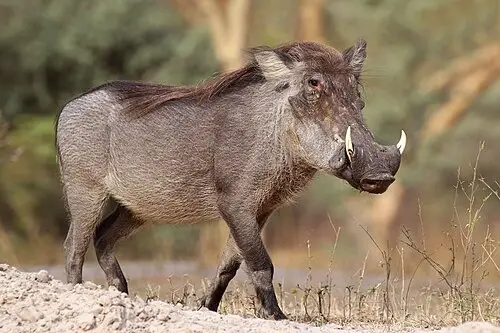
 📸 Photo
Photo: Charles J. Sharp · CC BY-SA 4.0 · Wikimedia Commons Source
Common Warthog
Phacochoerus africanus (Common Warthog · イボイノシシ)
💡 Everyday Comparisons for Size, Mass & Speed
- 💡 Its meat is used for local consumption and urban trade, and its high reproductive rate makes it popular on game ranches (Animal Diversity Web).
- 💡 A male's maximum tusk length of 635 mm is over 6 tenths of a 1 m ruler (Comparison).
- 💡 Its maximum weight of 150 kg equals 7 and a half 20 kg bags of rice (Comparison).
Reference standards: coach bus ~12 m, mid-size car ~4.9 m, compact car ~1 t, basketball hoop 3.05 m, credit card 8.56 cm.
Site-computed relative index from recorded values; not a formal scientific metric.
📖 1. Overview
The Common Warthog is a wild pig of the African savanna, famous for the wart-like bumps on its face and its large tusks.
🦴 2. Anatomy & Morphology
It has a large head with a mane running down the spine and three pairs of facial warts. The upper tusks of males measure 255–635 mm, longer than those of females.
🔍 3. Ecology & Behavior
An omnivore that mainly grazes on short grasses and also eats roots, berries, bark, and carrion, it kneels on calloused front wrists while grazing. Females and young live in groups, spending nights in burrows and foraging by day.
🇰🇷 4. Connection to Korea
No direct record connecting this species to Korea has been found.
📚 Sources & References
- • IUCN Red List LC (2016) — https://www.iucnredlist.org/species/41768/109669842
- • IUCN Red List category LC — latest assessment at iucnredlist.org
- • mammaldiversity.org — 1006366
- • iucnredlist.org — 109669842
- • wikidata.org — Q183255
- • commons.wikimedia.org — File:Nolan warthog (Phacochoerus africanus africanus).jpg
- • animaldiversity.org — Phacochoerus africanus
- • Silhouette: PhyloPic — Steven Traver · CC0 1.0
Recorded dimensions are widely cited representative estimates from public literature and may vary by study or specimen.