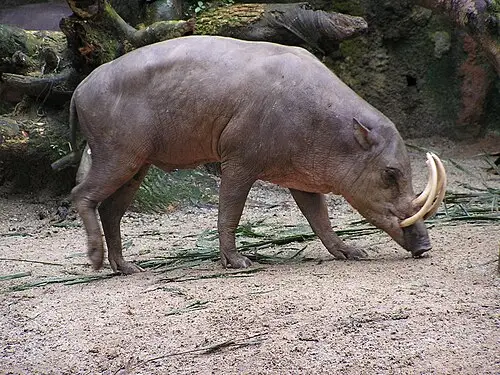
 📸 Photo
Photo: Masteraah at German Wikipedia · CC BY-SA 2.0 de · Wikimedia Commons Source
Sulawesi Babirusa
Babyrousa celebensis (Sulawesi Babirusa · スラウェシバビルサ)
💡 Everyday Comparisons for Size, Mass & Speed
- 💡 The male's 30 cm upper canine is the length of a 30 cm ruler (Comparison).
- 💡 Local people in Indonesia hunt this animal for food and sometimes catch young individuals to tame (Animal Diversity Web).
- 💡 Its maximum weight of 100 kg equals five 20 kg bags of rice (Comparison).
Reference standards: coach bus ~12 m, mid-size car ~4.9 m, compact car ~1 t, basketball hoop 3.05 m, credit card 8.56 cm.
Site-computed relative index from recorded values; not a formal scientific metric.
📖 1. Overview
The Sulawesi babirusa is a wild pig living in the humid forests of Sulawesi, Indonesia, famous for the male's upper canines that pierce right through the top of the snout as they grow.
🦴 2. Anatomy & Morphology
In males, the upper canines grow upward through the skin of the snout and can reach 30 cm in length. Its rough, brownish-gray skin has very little hair and lies in heavy folds.
🔍 3. Ecology & Behavior
Unlike other pigs, it does not root in the ground with its snout, feeding mainly on leaves, fallen fruits, and mushrooms. Gestation lasts 150–157 days, producing one or two piglets.
🇰🇷 4. Connection to Korea
No direct record connecting this species to Korea has been found.
📚 Sources & References
- • IUCN Red List VU (2016) — https://www.iucnredlist.org/species/136446/44142964
- • IUCN Red List category VU — latest assessment at iucnredlist.org
- • mammaldiversity.org — 1006362
- • iucnredlist.org — 44142964
- • wikidata.org — Q1934992
- • commons.wikimedia.org — File:Hirscheber1a.jpg
- • animaldiversity.org — Babyrousa babyrussa
- • Silhouette: PhyloPic — Jan A. Venter, Herbert H. T. Prins, David A. Balfour & Rob Slotow (vectorized by T. Michael Keesey) · CC BY 3.0 (Related taxon silhouette — Phacochoerus africanus)
Recorded dimensions are widely cited representative estimates from public literature and may vary by study or specimen.