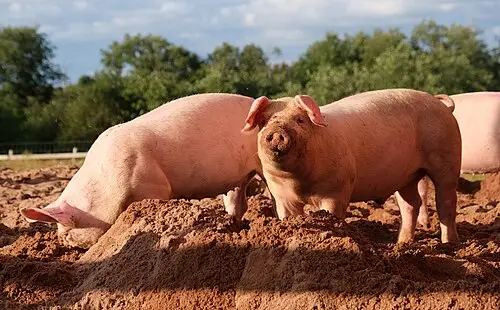
 📸 Photo
Photo: kallerna · CC BY-SA 4.0 · Wikimedia Commons Source
Domestic Pig
Sus domesticus (Domestic Pig · Domestic Pig)
Not Evaluated (NE) on the IUCN Red List yet.
💡 Everyday Comparisons for Size, Mass & Speed
- 💡 Pigs provide food for people and serve as a source of income for farm households (Animal Diversity Web).
- 💡 Studies show that mother sows can recognize their own piglets by smell alone thanks to their keen sense of smell (Animal Diversity Web).
Reference standards: coach bus ~12 m, mid-size car ~4.9 m, compact car ~1 t, basketball hoop 3.05 m, credit card 8.56 cm.
📖 1. Overview
The Domestic Pig is the domesticated form of the wild boar (Sus scrofa) and a major livestock animal raised for meat. Its wild ancestor is omnivorous.
🦴 2. Anatomy & Morphology
Its wild ancestor has a long, flat snout with a keen sense of smell. Adult wild boars are covered in thick, coarse bristles and have upper canines measuring 5–10 cm.
🔍 3. Ecology & Behavior
Domestic pigs mature early and can produce large litters up to twice a year. Starting about 24 hours after giving birth, a mother sow can distinguish her own piglets from others by scent.
🇰🇷 4. Connection to Korea
No direct record connecting this species to Korea has been found.
📚 Sources & References
- • IUCN Red List: not evaluated (NE) — cross-checked with the Wikidata conservation-status entry
- • mammaldiversity.org — 1006374
- • wikidata.org — Q125459958
- • commons.wikimedia.org — File:Pig farm Vampula 1.jpg
- • animaldiversity.org — Sus scrofa
- • Silhouette: PhyloPic — Gabriela Palomo-Munoz · CC BY 4.0
Recorded dimensions are widely cited representative estimates from public literature and may vary by study or specimen.