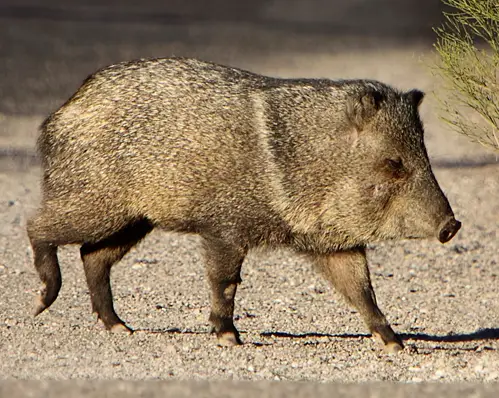
 📸 Photo
Photo: Alan Vernon · CC BY 2.0 · Wikimedia Commons Source
Collared Peccary
Dicotyles tajacu (Collared Peccary · Collared Peccary)
💡 Everyday Comparisons for Size, Mass & Speed
- 💡 For Indigenous peoples and rural communities in Central and South America, it is an important source of meat (Animal Diversity Web).
- 💡 It is estimated to consume an average of 8 percent of farm crops in South America (Animal Diversity Web).
- 💡 Its maximum body length of 106 cm is close to 1/4 the length of a passenger car (about 4.5 m) (Comparison).
Reference standards: coach bus ~12 m, mid-size car ~4.9 m, compact car ~1 t, basketball hoop 3.05 m, credit card 8.56 cm.
Site-computed relative index from recorded values; not a formal scientific metric.
📖 1. Overview
The Collared Peccary is a pig-like animal living from the southern United States through Central and South America, marked by a white band around its neck. It belongs to the peccary family rather than the pig family.
🦴 2. Anatomy & Morphology
Adults have coarse gray fur with a white collar across the front of the shoulders and a large scent gland on the rump ahead of the tail. They have 38 teeth, and the lower canines jut out like tusks.
🔍 3. Ecology & Behavior
A largely herbivorous omnivore, it eats mainly fruits in tropical forests. It is active at night in summer and during the day in winter, and each herd has one dominant male.
🇰🇷 4. Connection to Korea
No direct record connecting this species to Korea has been found.
📚 Sources & References
- • IUCN Red List LC (2011) — https://www.iucnredlist.org/species/41777/10562361
- • IUCN Red List category LC — latest assessment at iucnredlist.org
- • mammaldiversity.org — 1006380
- • iucnredlist.org — 10562361
- • wikidata.org — Q125498219
- • commons.wikimedia.org — File:Collared Peccary crossing the road (cropped).jpg
- • animaldiversity.org — Pecari tajacu
- • Silhouette: PhyloPic — Steven Traver · CC0 1.0
Recorded dimensions are widely cited representative estimates from public literature and may vary by study or specimen.