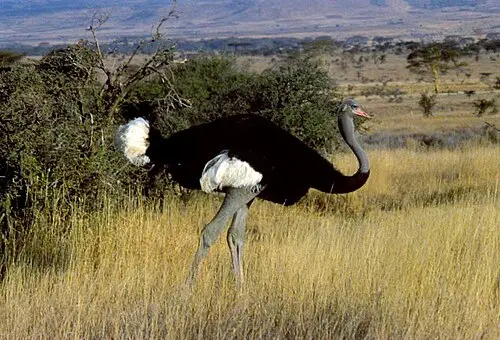
 📸 Photo
Photo: Christiaan Kooyman · Public domain · Wikimedia Commons Source
Somali Ostrich
Struthio molybdophanes (Somali Ostrich · ソマリダチョウ)
💡 Everyday Comparisons for Size, Mass & Speed
- 💡 A single egg weighs about 1.5 kg, roughly equal to 25 chicken eggs (taking 1 egg as 60 g, Comparison).
- 💡 Its weight of 130 kg is about 6 and a half 20 kg bags of rice (Comparison).
- 💡 Its running speed of 70 km/h is faster than a city road speed limit of 50 km/h (Comparison).
Reference standards: coach bus ~12 m, mid-size car ~4.9 m, compact car ~1 t, basketball hoop 3.05 m, credit card 8.56 cm.
Site-computed relative index from recorded values; not a formal scientific metric.
📖 1. Overview
The Somali Ostrich is a huge flightless bird living in northeastern Africa, formerly treated as a subspecies of the Common Ostrich but now recognized as a separate species.
🦴 2. Anatomy & Morphology
It has long, powerful legs with only two toes on each foot, and its eyes, about 5 cm in diameter, are the largest of any land animal. Males are black and white while females are grayish-brown (zoo sources describe ostriches as a group).
🔍 3. Ecology & Behavior
It feeds mainly on roots, leaves, and seeds along with small animals such as insects and lizards, and swallows sand and pebbles to grind food in its gizzard. Several females lay eggs in a single nest, and the male and females take turns incubating them for 42–46 days.
🇰🇷 4. Connection to Korea
No direct record connecting this species to Korea has been found.
📚 Sources & References
- • IUCN Red List VU (2022) — https://www.iucnredlist.org/species/22732795/208237218
- • IUCN Red List category VU — latest assessment at iucnredlist.org
- • doi.org — avilist.v2026
- • iucnredlist.org — 208237218
- • wikidata.org — Q1988064
- • commons.wikimedia.org — File:Somali ostrich.jpg
- • nationalzoo.si.edu — ostrich
- • animals.sandiegozoo.org — ostrich
- • Silhouette: PhyloPic — T. Michael Keesey (from a photo by Jamion Blackwell) · CC0 1.0 (Congeneric silhouette — Struthio)
Recorded dimensions are widely cited representative estimates from public literature and may vary by study or specimen.