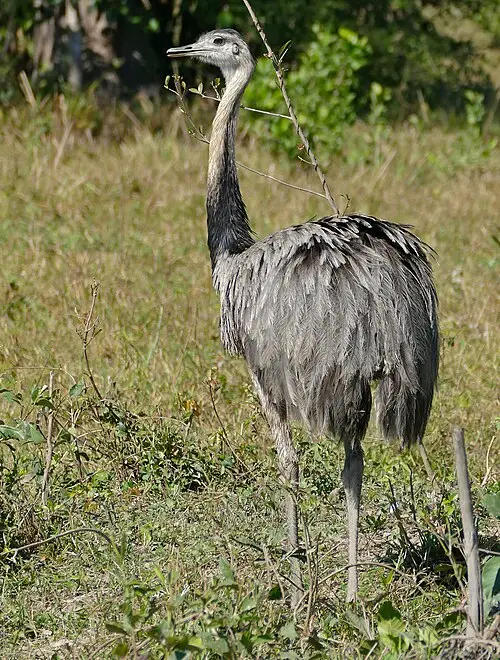
 📸 Photo
Photo: Bernard DUPONT from FRANCE · CC BY-SA 2.0 · Wikimedia Commons Source
Greater Rhea
Rhea americana (Greater Rhea · レア)
💡 Everyday Comparisons for Size, Mass & Speed
- 💡 Its weight of 36 kg is close to two 20 kg bags of rice (Comparison).
- 💡 It also enters fields of grain such as wheat and legume crops to feed.
- 💡 The male takes charge of incubating the eggs and raising the chicks.
Reference standards: coach bus ~12 m, mid-size car ~4.9 m, compact car ~1 t, basketball hoop 3.05 m, credit card 8.56 cm.
Site-computed relative index from recorded values; not a formal scientific metric.
📖 1. Overview
The Greater Rhea is a large flightless bird living in the grasslands of South America that looks similar to an ostrich.
🦴 2. Anatomy & Morphology
It has an oval-shaped body and a long neck; although flightless, its wings are relatively large and strong, used like sails for steering when running. Its head, neck, and rump are brownish-gray, the base of the neck and back are black, and the belly is white.
🔍 3. Ecology & Behavior
About 99% of its diet consists of plants such as grasses, legumes, and grain, while animals such as small birds, fish, snakes, and insects make up about 1%, and it also swallows pebbles. The male builds the nest, incubates eggs from several females for 20–30 days, and cares for the chicks for about 6 months; when threatened, it runs in zigzags using its wings and neck to steer.
🇰🇷 4. Connection to Korea
No direct record connecting this species to Korea has been found.
📚 Sources & References
- • IUCN Red List NT (2022) — https://www.iucnredlist.org/species/22678073/219615764
- • IUCN Red List category NT — latest assessment at iucnredlist.org
- • doi.org — avilist.v2026
- • iucnredlist.org — 219615764
- • wikidata.org — Q192044
- • commons.wikimedia.org — File:Greater Rhea (Rhea americana) (28234029614).jpg
- • animaldiversity.org — Rhea americana
- • Silhouette: PhyloPic — Ferran Sayol · CC0 1.0
Recorded dimensions are widely cited representative estimates from public literature and may vary by study or specimen.