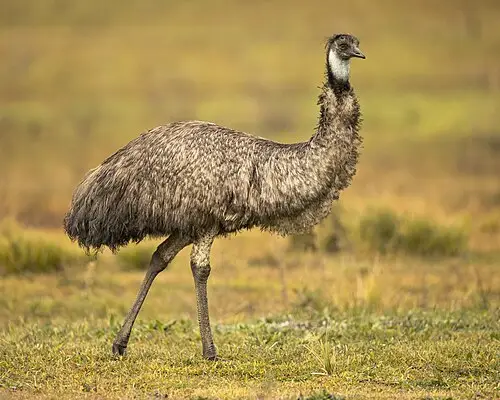
 📸 Photo
Photo: JJ Harrison ( https://www.jjharrison.com.au/ ) · CC BY-SA 4.0 · Wikimedia Commons Source
Emu
Dromaius novaehollandiae (Emu · エミュー)
💡 Everyday Comparisons for Size, Mass & Speed
- 💡 Its height of 1.9 m is similar to a tall adult man, and a male's mass of about 55 kg is around the weight of one adult human (Comparison).
- 💡 Emu oil has long been used as medicine and skin cream, and both Indigenous Australians and contemporary Australians also eat its meat (Animal Diversity Web).
Reference standards: coach bus ~12 m, mid-size car ~4.9 m, compact car ~1 t, basketball hoop 3.05 m, credit card 8.56 cm.
Site-computed relative index from recorded values; not a formal scientific metric.
📖 1. Overview
The emu is the largest living bird after the ostrich and the largest bird in Australia; it is flightless and widespread across Australia.
🦴 2. Anatomy & Morphology
It has a long neck and legs, tiny vestigial wings less than 20 cm long, and three toes on each foot. Chicks have black, brown, and cream longitudinal stripes that help them hide in grass and brush.
🔍 3. Ecology & Behavior
It eats fruits, seeds, insects, and small animals, traveling hundreds of miles in search of food and storing enough fat to lose up to half its body weight while fasting. While incubating the eggs, the male endures almost without eating.
🇰🇷 4. Connection to Korea
No direct record connecting this species to Korea has been found.
📚 Sources & References
- • IUCN Red List LC (2018) — https://www.iucnredlist.org/species/22678117/131902466
- • IUCN Red List category LC — latest assessment at iucnredlist.org
- • doi.org — avilist.v2026
- • iucnredlist.org — 131902466
- • wikidata.org — Q93208
- • commons.wikimedia.org — File:Emu 1 - Tidbinbilla.jpg
- • animaldiversity.org — Dromaius novaehollandiae
- • nationalzoo.si.edu — emu
- • Silhouette: PhyloPic — Andy Wilson · CC0 1.0
Recorded dimensions are widely cited representative estimates from public literature and may vary by study or specimen.