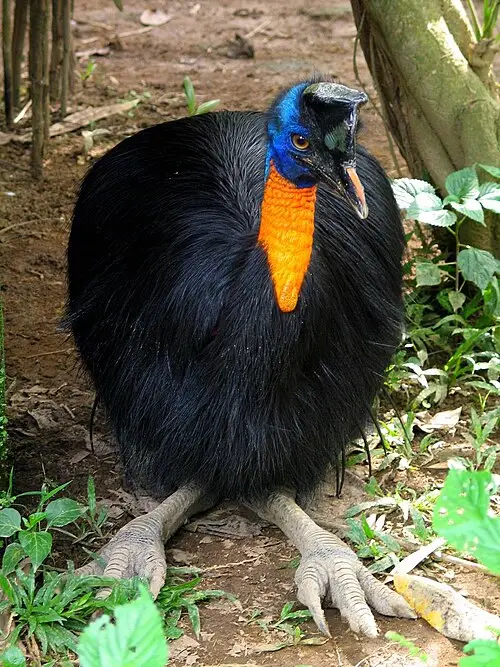
 📸 Photo
Photo: www.viajar24h.com · CC BY 2.0 · Wikimedia Commons Source
Northern Cassowary
Casuarius unappendiculatus (Northern Cassowary · パプアヒクイドリ)
💡 Everyday Comparisons for Size, Mass & Speed
- 💡 Its height of about 2 m is as tall as a doorway, and its maximum mass of 50 kg is about the weight of one adult human (Comparison).
- 💡 People in Papua New Guinea eat its meat and eggs, and by eating fruit and spreading seeds it helps forests regenerate; in one rare plant species, 92% of seeds sprout after passing through this bird's digestive tract compared with only 4% otherwise (Animal Diversity Web).
Reference standards: coach bus ~12 m, mid-size car ~4.9 m, compact car ~1 t, basketball hoop 3.05 m, credit card 8.56 cm.
Site-computed relative index from recorded values; not a formal scientific metric.
📖 1. Overview
The northern cassowary is a large flightless bird living in the lowland rainforests of Papua New Guinea, and is one of the two largest animals in the country.
🦴 2. Anatomy & Morphology
It has a hard helmet-like casque on top of its head, bright blue skin over most of its long neck, and a single red hanging wattle under its beak. Young birds are brown and acquire glossy black plumage at about 3 years of age.
🔍 3. Ecology & Behavior
A fruit specialist that eats hundreds of fruits a day, it also feeds on small animals and carrion. After mating, the female leaves and the male incubates the eggs for 47–56 days and cares for the chicks.
🇰🇷 4. Connection to Korea
No direct record connecting this species to Korea has been found.
📚 Sources & References
- • IUCN Red List LC (2017) — https://www.iucnredlist.org/species/22678114/118134784
- • IUCN Red List category LC — latest assessment at iucnredlist.org
- • doi.org — avilist.v2026
- • iucnredlist.org — 118134784
- • wikidata.org — Q843182
- • commons.wikimedia.org — File:Casuarius unappendiculatus -Northern Cassowary -head to
- • animaldiversity.org — Casuarius unappendiculatus
- • Silhouette: PhyloPic — Kai Caspar · CC BY 4.0 (Congeneric silhouette — Casuarius casuarius)
Recorded dimensions are widely cited representative estimates from public literature and may vary by study or specimen.