 📸 Photo
Photo: Quartl · CC BY-SA 3.0 · Wikimedia Commons Source
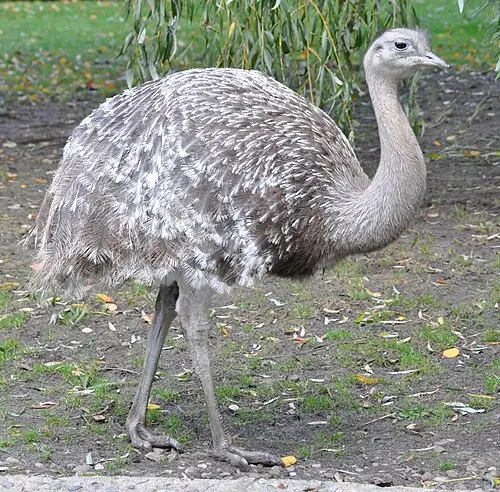
Lesser Rhea
Rhea pennata (Lesser Rhea · ダーウィンレア)
💡 Everyday Comparisons for Size, Mass & Speed
- 💡 Its weight of 25 kg is about one and a half 20 kg bags of rice, and its top speed of 60 km/h is faster than a typical city road speed limit of 50 km/h (Comparison).
- 💡 In South America, its feathers, meat, and skin are used, with the hides also made into rugs, and it helps ranches by walking alongside cattle and eating spiny burrs tangled in sheep wool (Animal Diversity Web).
Reference standards: coach bus ~12 m, mid-size car ~4.9 m, compact car ~1 t, basketball hoop 3.05 m, credit card 8.56 cm.
Site-computed relative index from recorded values; not a formal scientific metric.
📖 1. Overview
The Lesser Rhea is an ostrich-like flightless South American bird. It is the smaller of the two species in the rhea family and lives in open grasslands and high plateaus.
🦴 2. Anatomy & Morphology
Its smooth, soft brown feathers have white tips, and its relatively large wings are used to change direction while running. It has three toes on each foot and a claw at the tip of each wing.
🔍 3. Ecology & Behavior
It feeds mainly on plant matter such as roots, fruits, seeds, and leaves, along with small amounts of insects and small vertebrates. The male gathers eggs from several females into one nest, incubates them, and cares for the chicks.
🇰🇷 4. Connection to Korea
No direct record connecting this species to Korea has been found.
📚 Sources & References
- • IUCN Red List LC (2022) — https://www.iucnredlist.org/species/22678081/217016710
- • IUCN Red List category LC — latest assessment at iucnredlist.org
- • doi.org — avilist.v2026
- • iucnredlist.org — 217016710
- • wikidata.org — Q733120
- • commons.wikimedia.org — File:Pterocnemia pennata qtl1.jpg
- • animaldiversity.org — Pterocnemia pennata
- • birdsoftheworld.org — introduction
- • ebird.org — lesrhe2
- • Silhouette: PhyloPic — Kai Caspar · CC0 1.0
Recorded dimensions are widely cited representative estimates from public literature and may vary by study or specimen.