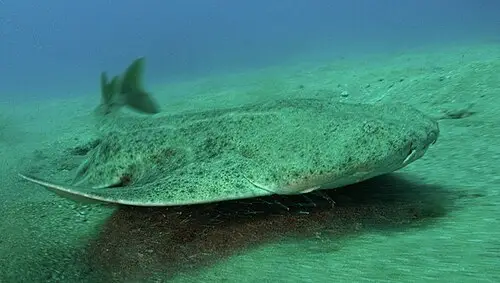
 📸 Photo
Photo: Philippe Guillaume · CC BY 2.0 · Wikimedia Commons Source
Angelshark
Squatina squatina (Angelshark · ホンカスザメ)
💡 Everyday Comparisons for Size, Mass & Speed
- 💡 A female's maximum length of 2.44 m is more than 40 cm longer than a bed (about 2 m) (Comparison).
- 💡 Its maximum weight of 80 kg is the weight of 4 bags of 20 kg rice (Comparison).
- 💡 It is targeted by anglers and also caught in small-scale commercial fisheries (FishBase).
Reference standards: coach bus ~12 m, mid-size car ~4.9 m, compact car ~1 t, basketball hoop 3.05 m, credit card 8.56 cm.
Site-computed relative index from recorded values; not a formal scientific metric.
📖 1. Overview
The angelshark is a flattened bottom-dwelling shark that lies buried in sand or mud with only its eyes showing during the day and swims at night. It moves to deeper waters in winter and returns to shallow waters in spring.
🦴 2. Anatomy & Morphology
It is a flattened bottom shark that lies sluggishly buried in sand or mud during the day with only its eyes protruding. Females grow up to 2.44 m and males up to 1.83 m.
🔍 3. Ecology & Behavior
It mainly eats flatfishes such as flounders, other bottom fish, skates and rays, crustaceans, and mollusks, and there is even a record of one swallowing a cormorant. At night, it rises off the bottom to swim.
🇰🇷 4. Connection to Korea
No direct record connecting this species to Korea has been found.
📚 Sources & References
- • IUCN Red List CR (2019) — https://www.iucnredlist.org/species/39332/117498371
- • IUCN Red List category CR — latest assessment at iucnredlist.org
- • catalogueoflife.org — 6ZFGH
- • iucnredlist.org — 117498371
- • wikidata.org — Q578842
- • commons.wikimedia.org — File:Squatina squatina tenerife.jpg
- • fishbase.se — Squatina-squatina.html
- • Silhouette: PhyloPic — author not recorded · CC0 1.0
Recorded dimensions are widely cited representative estimates from public literature and may vary by study or specimen.