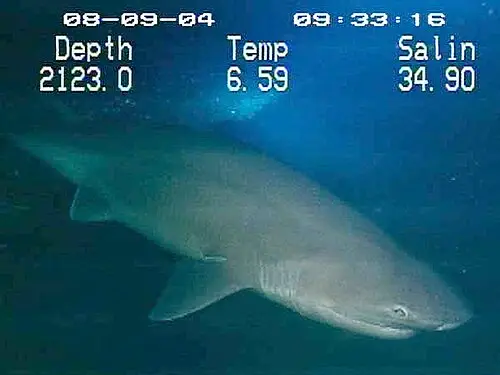
 📸 Photo
Photo: Public domain · Public domain · Wikimedia Commons Source
Bluntnose sixgill shark
Hexanchus griseus (Bluntnose sixgill shark · カグラザメ)
💡 Everyday Comparisons for Size, Mass & Speed
- 💡 Its maximum length of 6 m is about one and a half times the length of a passenger car (about 4.5 m) (Comparison).
- 💡 Its maximum weight of 590 kg equals about 30 bags of 20 kg rice (Comparison).
- 💡 It is caught for food using lines and nets, and is also targeted by sport anglers (Animal Diversity Web).
Reference standards: coach bus ~12 m, mid-size car ~4.9 m, compact car ~1 t, basketball hoop 3.05 m, credit card 8.56 cm.
Site-computed relative index from recorded values; not a formal scientific metric.
📖 1. Overview
The bluntnose sixgill shark is a large, stout deep-sea shark that stays deep during the day and rises near the surface at night. Because it has six pairs of gill slits, its English name calls it a “sixgill shark.”
🦴 2. Anatomy & Morphology
It has a short, blunt snout and a large, rounded mouth. Its eyes are large and green, and the lower jaw bears 6 rows of comb-shaped teeth on each side. The back is grayish-black to chocolate brown, the belly is grayish-white, and it has only a single dorsal fin.
🔍 3. Ecology & Behavior
It mainly preys on fishes, rays, and other sharks, and also eats crabs, shrimp, hagfish, lampreys, and marine mammals. Though it appears sluggish, it is surprisingly fast when chasing prey. In warm seasons, it comes up to shallow waters of 23 to 39 m by day and 3 m by night.
🇰🇷 4. Connection to Korea
It is a recorded species in Korea listed in the National List of Species of Korea.
📚 Sources & References
- • IUCN Red List NT (2020) — https://www.iucnredlist.org/species/10030/495630
- • IUCN Red List category NT — latest assessment at iucnredlist.org
- • catalogueoflife.org — 3LGK8
- • iucnredlist.org — 495630
- • 국가생물종목록(국립생물자원관) ktsn 120000474491 — https://species.nibr.go.kr/home/mainHome.do?cont_link=009&subMenu=009002&contCd=009002&ktsn=120000474491
- • wikidata.org — Q312293
- • commons.wikimedia.org — File:Six-gill shark.jpg
- • fishbase.se — Hexanchus-griseus.html
- • animaldiversity.org — Hexanchus griseus
- • Silhouette: PhyloPic — Ignacio Contreras · CC BY 3.0
Recorded dimensions are widely cited representative estimates from public literature and may vary by study or specimen.