 📸 Photo
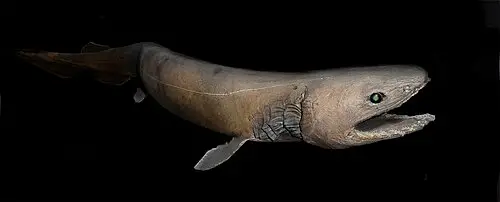
Photo: This illustration was made by Citron You must credit this : Citron / CC-BY-SA-3.0 · CC BY-SA 3.0 · Wikimedia Commons Source
Frilled shark
Chlamydoselachus anguineus (Frilled shark · ラブカ)
💡 Everyday Comparisons for Size, Mass & Speed
- 💡 Its maximum length of 2 m is slightly taller than an adult human, similar to the length of a bed (about 2 m) (Comparison).
- 💡 When caught as bycatch in nets or on longlines, it is ground into fishmeal or animal feed, or sometimes used as food (Animal Diversity Web, FishBase).
Reference standards: coach bus ~12 m, mid-size car ~4.9 m, compact car ~1 t, basketball hoop 3.05 m, credit card 8.56 cm.
📖 1. Overview
The Frilled shark is a primitive shark with an eel-like elongated body and six pairs of gill slits, living near deep sea bottoms. It is occasionally caught near the surface as well.
🦴 2. Anatomy & Morphology
Its body is long and slender with a long tail fin that makes it look like an eel, and its body color is chocolate brown. It has six pairs of gill slits with frilly skin margins, giving rise to the name Frilled shark. Its dorsal fin is small and set far back on the body.
🔍 3. Ecology & Behavior
With its sharp teeth, it eats small deep-sea fishes, squid, and other sharks, and also appears to feed on carrion sinking to the sea floor. It is ovoviviparous, giving birth to 2–10 young per litter. Although not dangerous, its teeth are sharp enough to have cut the hands of researchers examining its mouth.
🇰🇷 4. Connection to Korea
No direct record connecting this species to Korea has been found.
📚 Sources & References
- • IUCN Red List LC (2024) — https://www.iucnredlist.org/species/41794/124416882
- • IUCN Red List category LC — latest assessment at iucnredlist.org
- • catalogueoflife.org — 5Y8T6
- • iucnredlist.org — 124416882
- • wikidata.org — Q194312
- • commons.wikimedia.org — File:Chlamydoselachus anguineus2.jpg
- • fishbase.se — Chlamydoselachus-anguineus.html
- • animaldiversity.org — Chlamydoselachus anguineus
- • Silhouette: PhyloPic — C. Camilo Julián-Caballero · CC BY 3.0
Recorded dimensions are widely cited representative estimates from public literature and may vary by study or specimen.