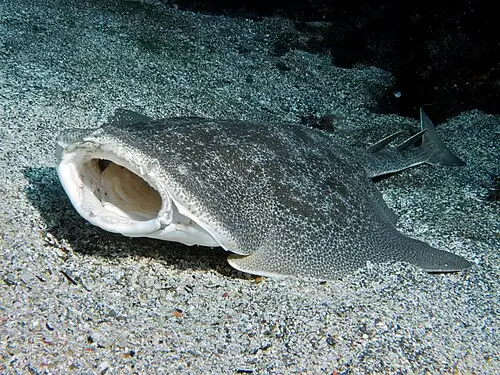
 📸 Photo
Photo: RYO SATO from Hamamatsu, Shizuoka, Japan · CC BY-SA 2.0 · Wikimedia Commons Source
Japanese angelshark
Squatina japonica (Japanese angelshark · カスザメ)
💡 Everyday Comparisons for Size, Mass & Speed
- 💡 Its maximum body length of 2 m is similar to the height of a front door (about 2 m) (Comparison).
- 💡 A body length of 2 m is about 30 cm longer than an adult human's height (about 1.7 m) (Comparison).
Reference standards: coach bus ~12 m, mid-size car ~4.9 m, compact car ~1 t, basketball hoop 3.05 m, credit card 8.56 cm.
📖 1. Overview
The Japanese angelshark is a shark living on sandy bottoms of shallow seas in Japan, the Yellow Sea, Korea, and northern China. It is assessed as Critically Endangered (CR, 2021) on the IUCN Red List.
🦴 2. Anatomy & Morphology
FishBase notes that it is a bottom-dwelling shark growing up to 2 m, living on or near sandy bottoms.
🔍 3. Ecology & Behavior
It is a carnivore that feeds on bottom-dwelling animals. It is ovoviviparous, and embryos inside the mother grow by feeding solely on yolk.
🇰🇷 4. Connection to Korea
FishBase records it from Japan, the Yellow Sea, Korea, and northern China in the northwestern Pacific, and it is also listed on the National List of Species of Korea as "Jeonjarisangeo" (Korean name).
📚 Sources & References
- • IUCN Red List CR (2021) — https://www.iucnredlist.org/species/161558/134194013
- • IUCN Red List category CR — latest assessment at iucnredlist.org
- • catalogueoflife.org — 6ZFHN
- • iucnredlist.org — 134194013
- • 국가생물종목록(국립생물자원관) ktsn 120000057330 — https://species.nibr.go.kr/home/mainHome.do?cont_link=009&subMenu=009002&contCd=009002&ktsn=120000057330
- • wikidata.org — Q28832
- • commons.wikimedia.org — File:Squatina japonica2.jpg
- • fishbase.se — Squatina-japonica.html
- • species.nibr.go.kr — mainHome.do
- • Silhouette: PhyloPic — M Kolmann · CC0 1.0 (Congeneric silhouette — Squatina)
Recorded dimensions are widely cited representative estimates from public literature and may vary by study or specimen.