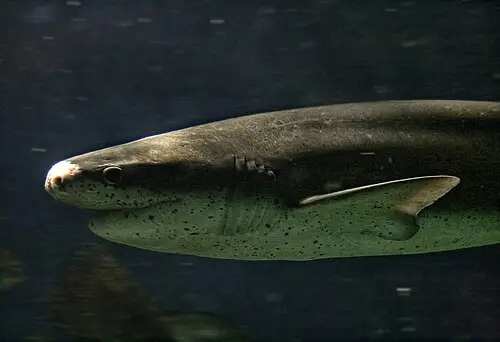
 📸 Photo
Photo: José María Pérez Nuñez from Buenos Aires, Argentina · CC BY-SA 2.0 · Wikimedia Commons Source
Broadnose sevengill shark
Notorynchus cepedianus (Broadnose sevengill shark · エビスザメ)
💡 Everyday Comparisons for Size, Mass & Speed
- 💡 Its body length of about 2.5 m recorded in the National List of Species of Korea is slightly longer than a bed (about 2 m) (Comparison).
- 💡 A newborn pup of 40–50 cm is about 1.5 times the long side of an A4 sheet of paper (29.7 cm) (Comparison).
- 💡 Living off the South Sea and Jeju Island, its high-quality meat is sold for food and its skin and liver oil are also used (National List of Species of Korea, Animal Diversity Web).
Reference standards: coach bus ~12 m, mid-size car ~4.9 m, compact car ~1 t, basketball hoop 3.05 m, credit card 8.56 cm.
Site-computed relative index from recorded values; not a formal scientific metric.
📖 1. Overview
The broadnose sevengill shark is a large coastal shark with seven pairs of gill slits, also recorded in the South Sea, Jeju Island, and southern East Sea of Korea. It usually cruises slowly near the bottom and dashes rapidly when ambushing prey.
🦴 2. Anatomy & Morphology
Its body is elongated and flattened from top to bottom, with only a single dorsal fin set far back on the body. Its back is bluish-gray or olive-brown scattered with dark spots. It has comb-shaped teeth in the lower jaw and jagged teeth in the upper jaw.
🔍 3. Ecology & Behavior
An opportunistic hunter that feeds indiscriminately on sharks, rays, dolphins, seals, fish, and squid, it also hunts in groups. It gives birth to live young in shallow coastal waters in summer, with newborns measuring 40–50 cm.
🇰🇷 4. Connection to Korea
It is listed on the National List of Species of Korea as inhabiting the South Sea, Jeju Island, and southern East Sea.
📚 Sources & References
- • IUCN Red List VU (2020) — https://www.iucnredlist.org/species/39324/268790096
- • IUCN Red List category VU — latest assessment at iucnredlist.org
- • catalogueoflife.org — 47YCK
- • iucnredlist.org — 268790096
- • 국가생물종목록(국립생물자원관) ktsn 120000057317 — https://species.nibr.go.kr/home/mainHome.do?cont_link=009&subMenu=009002&contCd=009002&ktsn=120000057317
- • wikidata.org — Q377591
- • commons.wikimedia.org — File:Notorynchus cepedianus 2.jpg
- • fishbase.se — Notorynchus-cepedianus.html
- • species.nibr.go.kr — mainHome.do
- • animaldiversity.org — Notorynchus cepedianus
- • Silhouette: PhyloPic — Ignacio Contreras · CC BY 3.0
Recorded dimensions are widely cited representative estimates from public literature and may vary by study or specimen.