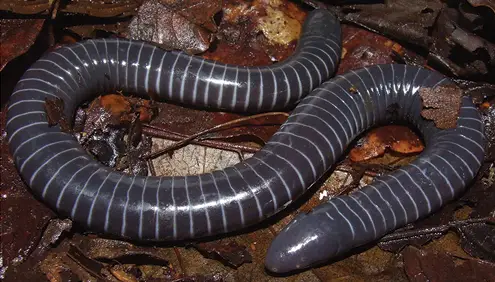
 📸 Photo
Photo: Dias, I · CC BY 4.0 · Wikimedia Commons Source
Ringed Caecilian
Siphonops annulatus (Ringed Caecilian · Ringed Caecilian)
💡 Everyday Comparisons for Size, Mass & Speed
- 💡 This subterranean animal has been reported to thrive in cacao plantations in southern Bahia, Brazil, where cacao—the raw material for chocolate—is grown under the shade of tall trees (the cabruca system).
- 💡 A juvenile with a total length of 120 mm is about 1.4 times the long side of a credit card (85.6 mm) (Comparison).
Reference standards: coach bus ~12 m, mid-size car ~4.9 m, compact car ~1 t, basketball hoop 3.05 m, credit card 8.56 cm.
📖 1. Overview
The Ringed Caecilian is a subterranean amphibian living in South America, known for its young feeding on their mother's skin as they grow. It has the widest distribution among terrestrial caecilians and is listed as Least Concern (LC, 2023 assessment) on the IUCN Red List.
🦴 2. Anatomy & Morphology
Legless with a ring-segmented body, small eyes, and a pair of sensory tentacles, its skin is rich in mucus glands and poison glands. Studies have shown that its poison glands are similar in structure to those of salamanders.
🔍 3. Ecology & Behavior
The young have elongated teeth adapted for feeding on their mother's skin. A juvenile with a total length of 120 mm had 44 spoon-shaped teeth with small hooks on its lower jaw, and young have also been observed gathering around the mother's cloaca at the tip of her body to drink fluid.
🇰🇷 4. Connection to Korea
No direct record connecting this species to Korea has been found.
📚 Sources & References
- • IUCN Red List LC (2023) — https://www.iucnredlist.org/species/59593/180649042
- • IUCN Red List category LC — latest assessment at iucnredlist.org
- • catalogueoflife.org — 4XQC7
- • iucnredlist.org — 180649042
- • wikidata.org — Q608757
- • commons.wikimedia.org — File:Siphonops annulatus IRDias 2014.png
- • pmc.ncbi.nlm.nih.gov — PMC2610157
- • pmc.ncbi.nlm.nih.gov — PMC8617868
- • Silhouette: PhyloPic — Yan Wong from illustration by Charles Orbigny · CC0 1.0
Recorded dimensions are widely cited representative estimates from public literature and may vary by study or specimen.