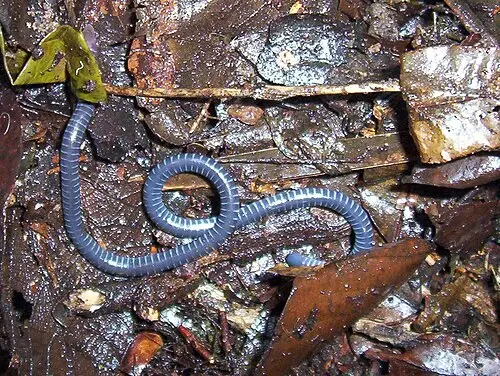
 📸 Photo
Photo: Milvus · CC BY-SA 3.0 · Wikimedia Commons Source
Taita Hills Caecilian
Boulengerula taitana (Taita Hills Caecilian · Taita Hills Caecilian)
💡 Everyday Comparisons for Size, Mass & Speed
- 💡 The way offspring grow by eating the outer layer of their mother's skin can be likened to a mother nourishing her baby with her own body, much as human infants nurse on breast milk (Comparison).
- 💡 A congener, the Sagalla Caecilian (Boulengerula niedeni, a different species), has been the focus of conservation education and habitat restoration projects in the Taita Hills region of Kenya.
Reference standards: coach bus ~12 m, mid-size car ~4.9 m, compact car ~1 t, basketball hoop 3.05 m, credit card 8.56 cm.
📖 1. Overview
The Taita Hills Caecilian is an egg-laying caecilian from East Africa famous for its remarkable parental care, in which young grow by feeding on the outer layer of their mother's skin. It is listed as Endangered (EN, assessed in 2021) on the IUCN Red List.
🦴 2. Anatomy & Morphology
It is an oviparous species with direct development (no tadpole stage), and the skin of brooding females transforms to become rich in nutrients for the offspring. The young possess specialized teeth designed to peel and eat this outer skin layer.
🔍 3. Ecology & Behavior
Its eggs undergo direct development into miniature young without a tadpole stage. The female stays with her young and offers her own skin as food, a form of maternal care reported to last up to three months in caecilians.
🇰🇷 4. Connection to Korea
No direct record connecting this species to Korea has been found.
📚 Sources & References
- • IUCN Red List EN (2021) — https://www.iucnredlist.org/species/59498/158472342
- • IUCN Red List category EN — latest assessment at iucnredlist.org
- • catalogueoflife.org — MR72
- • iucnredlist.org — 158472342
- • wikidata.org — Q677689
- • commons.wikimedia.org — File:Boulengerula taitanus 1.jpg
- • nature.com — nature04403
- • pmc.ncbi.nlm.nih.gov — PMC10184399
- • pmc.ncbi.nlm.nih.gov — PMC2610157
- • pmc.ncbi.nlm.nih.gov — PMC4914579
Recorded dimensions are widely cited representative estimates from public literature and may vary by study or specimen.