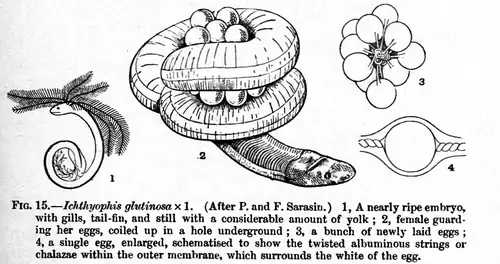
 📸 Photo
Photo: Hans Gadow · Public domain · Wikimedia Commons Source
Ceylon Caecilian
Ichthyophis glutinosus (Ceylon Caecilian · Ceylon Caecilian)
💡 Everyday Comparisons for Size, Mass & Speed
- 💡 Its length of 29 cm is almost the same as the long side of a sheet of A4 paper (29.7 cm) (Comparison).
- 💡 ADW suggests under 'Positive Impacts' that by eating earthworms and digging burrows that help water soak in and aerate the soil, it may benefit agricultural land.
Reference standards: coach bus ~12 m, mid-size car ~4.9 m, compact car ~1 t, basketball hoop 3.05 m, credit card 8.56 cm.
📖 1. Overview
The Ceylon Caecilian is a legless, tube-bodied amphibian that spends most of its life underground in soil. It is assessed as Vulnerable (VU, 2020 assessment) on the IUCN Red List.
🦴 2. Anatomy & Morphology
Measuring 13–29 cm in length, it has no legs, a yellow longitudinal stripe along each side of its purple-and-brown body, worm-like ring folds, and mucus glands. Its head is pointed with tiny eyes, a pair of sensory tentacles, and two broad bands just behind the head.
🔍 3. Ecology & Behavior
Solitary and active at night, it digs with its head to create large interconnected burrows; larvae eat bloodworms while adults eat earthworms, dragging prey into their burrows to crush and swallow. Females lay an average of 12–20 eggs per clutch, and during the dry season they burrow very deep in search of moist soil.
🇰🇷 4. Connection to Korea
No direct record connecting this species to Korea has been found.
📚 Sources & References
- • IUCN Red List VU (2020) — https://www.iucnredlist.org/species/59618/156587157
- • IUCN Red List category VU — latest assessment at iucnredlist.org
- • catalogueoflife.org — 6N5SH
- • iucnredlist.org — 156587157
- • wikidata.org — Q1058039
- • commons.wikimedia.org — File:CaecilianNHM.png
- • animaldiversity.org — Ichthyophis glutinosus
- • Silhouette: PhyloPic — Venu Govindappa (original photograph) · CC BY 4.0 (Related taxon silhouette — Uraeotyphlus narayani habitus)
Recorded dimensions are widely cited representative estimates from public literature and may vary by study or specimen.