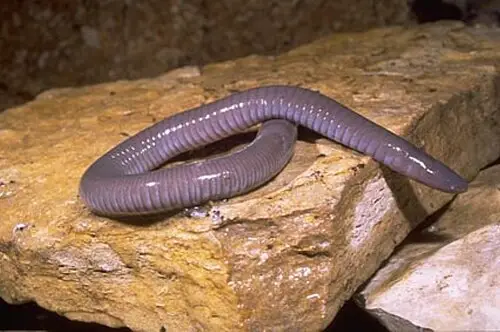
 📸 Photo
Photo: Franco Andreone - see authorization · CC BY-SA 2.5 · Wikimedia Commons Source
Mexican Caecilian
Dermophis mexicanus (Mexican Caecilian · Mexican Caecilian)
💡 Everyday Comparisons for Size, Mass & Speed
- 💡 Its known elevation of up to about 3,000 m above sea level is around 1.5 times the height of Hallasan in Korea (1,947 m) (Comparison).
- 💡 Because it is rarely seen by people—so much so that a first record from Costa Rica was reported—distribution surveys continue, and researchers in Chiapas, Mexico have studied whether protected areas can safeguard this species under climate change.
Reference standards: coach bus ~12 m, mid-size car ~4.9 m, compact car ~1 t, basketball hoop 3.05 m, credit card 8.56 cm.
📖 1. Overview
The Mexican Caecilian is a caecilian living in soil and leaf litter in Central America that gives birth to live young. It is assessed as Least Concern (LC, 2020) on the IUCN Red List.
🦴 2. Anatomy & Morphology
It is a legless, subterranean amphibian; a study examining the eyes of several caecilians including this species reported that a cone photopigment gene responsive to long-wavelength light remains functional despite a long history of underground life. No body length figures were found in the official sources consulted.
🔍 3. Ecology & Behavior
Along with close relatives in the same family, it burrows through shallow soil and leaf litter, emerging at dawn and dusk—especially during light rain—to forage. In Chiapas, Mexico, its known elevation ranges from lowlands up to about 3,000 m above sea level.
🇰🇷 4. Connection to Korea
No direct record connecting this species to Korea has been found.
📚 Sources & References
- • IUCN Red List LC (2020) — https://www.iucnredlist.org/species/59545/53988419
- • IUCN Red List category LC — latest assessment at iucnredlist.org
- • catalogueoflife.org — 34XMH
- • iucnredlist.org — 53988419
- • wikidata.org — Q1759933
- • commons.wikimedia.org — File:Dermophis mexicanus.jpg
- • pmc.ncbi.nlm.nih.gov — PMC11839130
- • frontiersin.org — full
- • Silhouette: PhyloPic — Jose Carlos Arenas-Monroy · CC0 1.0
Recorded dimensions are widely cited representative estimates from public literature and may vary by study or specimen.