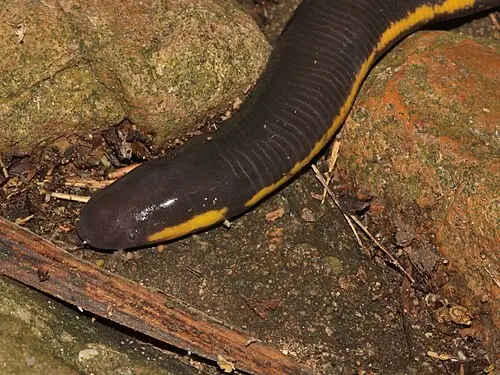
 📸 Photo
Photo: ian_dugdale · CC BY 4.0 · Wikimedia Commons Source
Koh Tao Caecilian
Ichthyophis kohtaoensis (Koh Tao Caecilian · Koh Tao Caecilian)
💡 Everyday Comparisons for Size, Mass & Speed
- 💡 The total length of 30–40 cm in female specimens is slightly longer than the long side of an A4 sheet of paper (29.7 cm) (Comparison).
- 💡 Climate models project that its current suitable area (about 186,420 km²) could shrink by more than 42.5% under climate change, and even its current area is nearly twice the size of South Korea (about 100,000 km²) (Comparison).
Reference standards: coach bus ~12 m, mid-size car ~4.9 m, compact car ~1 t, basketball hoop 3.05 m, credit card 8.56 cm.
📖 1. Overview
The Koh Tao Caecilian is a legless amphibian (caecilian) that looks like a snake or earthworm and is rarely recorded in humid lowlands of southern China such as Guangdong, Guangxi, and Yunnan. It is listed as Data Deficient (DD, 2021 assessment) on the IUCN Red List.
🦴 2. Anatomy & Morphology
Caecilians lack legs and have ring-like folds along the body, small eyes, and a pair of sensory tentacles on the head. Eleven female specimens used in a study had total lengths of 302–399 mm (written as 'Ichthyophis cf. kohtaoensis' in the paper).
🔍 3. Ecology & Behavior
Juveniles live in water while adults live on land and underground in soil, and females build underground nests, lay eggs, and guard them for a long period. Short-term sperm storage in the female's oviduct before laying yolk-rich eggs has been confirmed.
🇰🇷 4. Connection to Korea
No direct record connecting this species to Korea has been found.
📚 Sources & References
- • IUCN Red List DD (2021) — https://www.iucnredlist.org/species/59623/55068895
- • IUCN Red List category DD — latest assessment at iucnredlist.org
- • catalogueoflife.org — 6N64B
- • iucnredlist.org — 55068895
- • wikidata.org — Q962881
- • commons.wikimedia.org — File:Ichthyophis kohtaoensis 129267228.jpg
- • pmc.ncbi.nlm.nih.gov — PMC13362282
- • pmc.ncbi.nlm.nih.gov — PMC3418217
- • pmc.ncbi.nlm.nih.gov — PMC8617868
- • pmc.ncbi.nlm.nih.gov — PMC11839130
- • Silhouette: PhyloPic — Venu Govindappa (original photograph) · CC BY 4.0 (Related taxon silhouette — Uraeotyphlus narayani habitus)
Recorded dimensions are widely cited representative estimates from public literature and may vary by study or specimen.