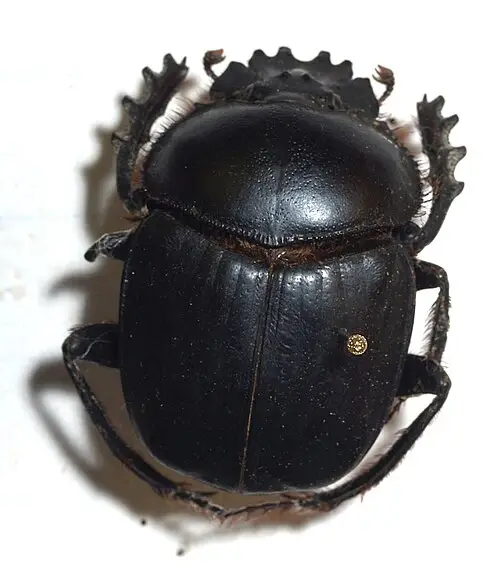
 📸 Photo
Photo: Sarefo · CC BY-SA 3.0 · Wikimedia Commons Source
Sacred scarab
Scarabaeus sacer (Sacred scarab · ヒジリタマオシコガネ)
Not Evaluated (NE) on the IUCN Red List yet.
💡 Everyday Comparisons for Size, Mass & Speed
- 💡 A body length of 33 mm is slightly longer than the diameter of a Korean 500-won coin (26.5 mm) (Comparison).
- 💡 The National List of Species of Korea lists domestic records from places such as Daegu, Andong, Busan, Jeonju, and Jindo, but notes that it is now extremely rare in Korea.
Reference standards: coach bus ~12 m, mid-size car ~4.9 m, compact car ~1 t, basketball hoop 3.05 m, credit card 8.56 cm.
📖 1. Overview
The sacred scarab is a dung beetle (family Scarabaeidae) that rolls the dung of large herbivores to eat and feed its young, distributed across central and northern Asia and southern Europe.
🦴 2. Anatomy & Morphology
Measuring 20–33 mm long and 10.5–18 mm wide, its body is short, broadly oval, and black. The front margin of the clypeus has 6 saw-like teeth, and the outer edge of the foreleg tibia has 4 large teeth.
🔍 3. Ecology & Behavior
It rolls the dung of large herbivores into underground burrows to eat or store as food for its offspring. In Korea, it once lived wild in the Sinduri coastal dunes of Taean, Chungcheongnam-do, but has become locally extinct there.
🇰🇷 4. Connection to Korea
The National List of Species of Korea records that it is extremely rare in Korea, became extinct in the Sinduri dunes, and is legally prohibited from export abroad for species conservation.
📚 Sources & References
- • IUCN Red List: not evaluated (NE) — cross-checked with the Wikidata conservation-status entry
- • catalogueoflife.org — 4V2G9
- • 국가생물종목록(국립생물자원관) ktsn 120000018785 — https://species.nibr.go.kr/home/mainHome.do?cont_link=009&subMenu=009002&contCd=009002&ktsn=120000018785
- • wikidata.org — Q1750802
- • commons.wikimedia.org — File:Scarabaeus.sacer.jpg
- • species.nibr.go.kr — mainHome.do
- • Silhouette: PhyloPic — Edwin Price · CC BY 4.0 (Related taxon silhouette — Hylamorpha elegans)
Recorded dimensions are widely cited representative estimates from public literature and may vary by study or specimen.