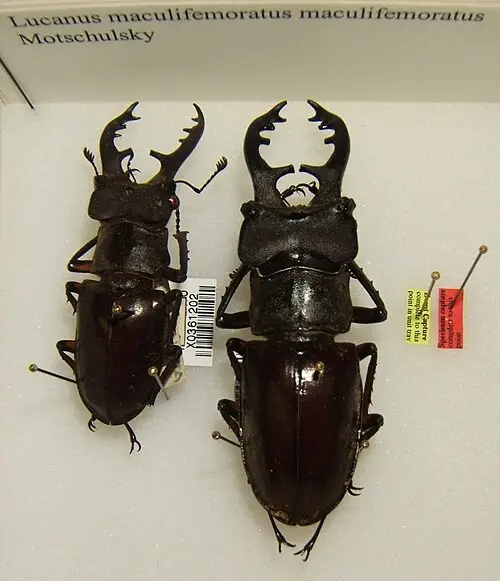
 📸 Photo
Photo: Shawn Hanrahan · CC BY-SA 2.5 · Wikimedia Commons Source
Miyama stag beetle
Lucanus maculifemoratus (Miyama stag beetle · ミヤマクワガタ)
Not Evaluated (NE) on the IUCN Red List yet.
💡 Everyday Comparisons for Size, Mass & Speed
- 💡 A male's maximum body length of 51 mm is almost the same as two Korean 500-won coins (26.5 mm in diameter) placed side by side (53 mm) (Comparison).
- 💡 The National List of Species of Korea notes that adults can be seen from June to September, gather on oak sap, and fly to lights at night.
Reference standards: coach bus ~12 m, mid-size car ~4.9 m, compact car ~1 t, basketball hoop 3.05 m, credit card 8.56 cm.
📖 1. Overview
The miyama stag beetle (subspecies Lucanus maculifemoratus dybowskyi) is a beetle in the family Lucanidae that lives throughout Korea and is also distributed in the Russian Far East, Japan, and northern China.
🦴 2. Anatomy & Morphology
Males have thick, strong mandibles curving downward and projections on the back of the head that flare out wide like elephant ears. The body is glossy reddish brown to blackish brown, and males vary from small to large individuals, with larger males having sturdier mandibles.
🔍 3. Ecology & Behavior
Larvae live in damp places such as well-rotted oak logs and take 2–3 years to become adults. Adults gather on oak sap from June to September and fly toward lights at night.
🇰🇷 4. Connection to Korea
It is listed as 'Sa-seum-beol-le' (Korean name, L. m. dybowskyi) on the National List of Species of Korea and is recorded as inhabiting all of Korea.
📚 Sources & References
- • IUCN Red List: not evaluated (NE) — cross-checked with the Wikidata conservation-status entry
- • catalogueoflife.org — 72P6P
- • 국가생물종목록(국립생물자원관) ktsn 120000017683 — https://species.nibr.go.kr/home/mainHome.do?cont_link=009&subMenu=009002&contCd=009002&ktsn=120000017683
- • wikidata.org — Q1142147
- • commons.wikimedia.org — File:Lucanus maculifemoratus maculifemoratus sjh.jpg
- • species.nibr.go.kr — mainHome.do
- • Silhouette: PhyloPic — Margot Michaud · CC0 1.0 (Congeneric silhouette — Lucanus)
Recorded dimensions are widely cited representative estimates from public literature and may vary by study or specimen.