 📸 Photo
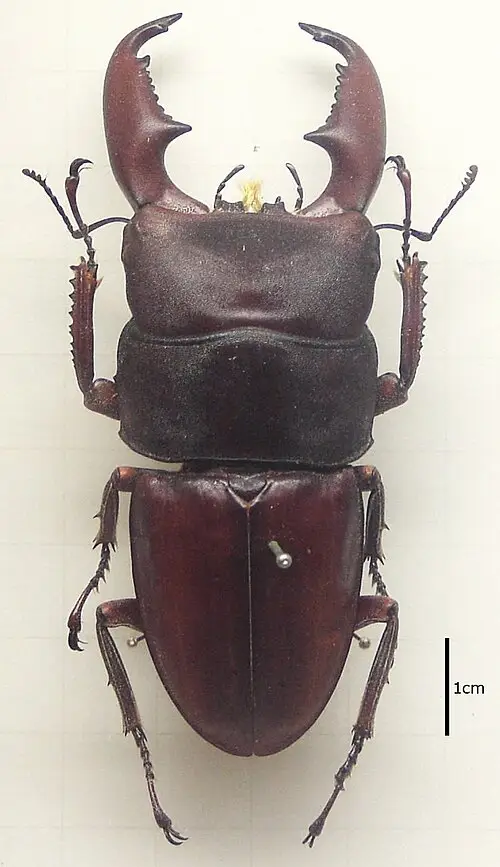
Photo: User:Sarefo · CC BY-SA 3.0 · Wikimedia Commons Source
Giant stag beetle
Serrognathus titanus (Giant stag beetle · Giant stag beetle)
Not Evaluated (NE) on the IUCN Red List yet.
💡 Everyday Comparisons for Size, Mass & Speed
- 💡 A maximum male body length of 50 mm is slightly more than half the long side of a credit card (85.6 mm) (Comparison).
- 💡 Full-grown larvae usually reach 15–20 g, weighing as much as two or three Korean 500-won coins (7.7 g each), and the Rural Development Administration advises rearing them one per bottle because they can injure each other.
Reference standards: coach bus ~12 m, mid-size car ~4.9 m, compact car ~1 t, basketball hoop 3.05 m, credit card 8.56 cm.
📖 1. Overview
The giant stag beetle is a large species in the family Lucanidae (order Coleoptera), distributed throughout Korea as well as in China and Japan (Tsushima).
🦴 2. Anatomy & Morphology
Its body is black, broad, and flattened, and its head is nearly rectangular. The male's mandibles extend straight before curving inward at the tips, bearing one thick tooth near the base, small saw-like teeth in the middle, and one small tooth near the tip pointing inward.
🔍 3. Ecology & Behavior
Adults gather on tree sap or ripe fruit from late spring to autumn and fly to lights at night. Larvae grow by feeding on decaying oak wood for 1–2 years, and males fight each other with their mandibles.
🇰🇷 4. Connection to Korea
Materials from the Rural Development Administration record its domestic distribution as nationwide, and it is listed as 'Neop-jeok-sa-seum-beol-le' (Korean name) under the name Dorcus titanus castanicolor on the National List of Species of Korea.
📚 Sources & References
- • IUCN Red List: not evaluated (NE) — cross-checked with the Wikidata conservation-status entry
- • catalogueoflife.org — 4WXXD
- • wikidata.org — Q2679352
- • commons.wikimedia.org — File:Eurytrachelus.titanus.jpg
- • genebank.rda.go.kr — insectView.bo
- • species.nibr.go.kr — mainHome.do
- • Silhouette: PhyloPic — Melissa Broussard · CC BY 3.0 (Related taxon silhouette — Platycerus)
Recorded dimensions are widely cited representative estimates from public literature and may vary by study or specimen.