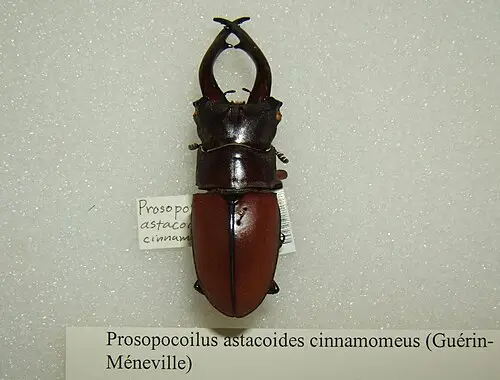
 📸 Photo
Photo: No machine-readable author provided. Kugamazog~commonswiki assumed (based on copyright claims). · CC BY-SA 2.5 · Wikimedia Commons Source
Common red stag beetle
Prosopocoilus astacoides (Common red stag beetle · アスタコイデスノコギリクワガタ)
Not Evaluated (NE) on the IUCN Red List yet.
🇰🇷 Class II endangered wildlife (Korea) (subspecies Prosopocoilus astacoides blanchardi)
💡 Everyday Comparisons for Size, Mass & Speed
- 💡 A maximum male body length of 67 mm is about 2.5 times the diameter of a Korean 500-won coin (26.5 mm) (Comparison).
- 💡 Indiscriminate collecting due to its popularity among collectors is cited as one reason for its decline. Jeju Technopark reported releasing artificially bred individuals into three villages on Jeju Island in June 2026.
Reference standards: coach bus ~12 m, mid-size car ~4.9 m, compact car ~1 t, basketball hoop 3.05 m, credit card 8.56 cm.
📖 1. Overview
The common red stag beetle lives mainly in broad-leaved forests of Jeju Island in Korea, marked with two black spots on the thorax. It is a Class II endangered wildlife species in Korea.
🦴 2. Anatomy & Morphology
Its body is yellowish brown or pale brown, with a central vertical line and a black spot on each side of the pronotum. Males have slender, long mandibles curving inward, with 4–5 sharp teeth near the tip.
🔍 3. Ecology & Behavior
Adults are active from June to September and feed on the sap of broad-leaved trees. Females gouge grooves into rotten wood to lay eggs, and most individuals overwinter as larvae.
🇰🇷 4. Connection to Korea
It is a Class II endangered wildlife species (Korea; listed at the subspecies level on the National List of Species of Korea). In Korea it mainly inhabits broad-leaved forests on Jeju Island, with a record of observation at Naejangsan in Jeongeup in 2001.
📚 Sources & References
- • 멸종위기 야생생물 Ⅱ급 (아종 Prosopocoilus astacoides blanchardi) — 국가생물종목록(국립생물자원관) ktsn 120000017744 — https://species.nibr.go.kr/home/mainHome.do?cont_link=009&subMenu=009002&contCd=009002&ktsn=120000017744
- • IUCN Red List: not evaluated (NE) — cross-checked with the Wikidata conservation-status entry
- • Korean protection status: Class II endangered wildlife (Korea) (subspecies Prosopocoilus astacoides blanchardi)
- • catalogueoflife.org — 7ZQDG
- • 국가생물종목록(국립생물자원관) ktsn 120000017744 — https://species.nibr.go.kr/home/mainHome.do?cont_link=009&subMenu=009002&contCd=009002&ktsn=120000017744
- • 국가생물종목록(국립생물자원관) ktsn 120000017745 — https://species.nibr.go.kr/home/mainHome.do?cont_link=009&subMenu=009002&contCd=009002&ktsn=120000017745
- • wikidata.org — Q141545
- • commons.wikimedia.org — File:Prosopocoilus astacoides cinnamomeus sjh.jpg
- • nie.re.kr — view.do
- • bok.or.kr — contents.do
- • newsseoul.co.kr — 1065589836234273
- • Silhouette: PhyloPic — Melissa Broussard · CC BY 3.0 (Related taxon silhouette — Platycerus)
Recorded dimensions are widely cited representative estimates from public literature and may vary by study or specimen.