 📸 Photo
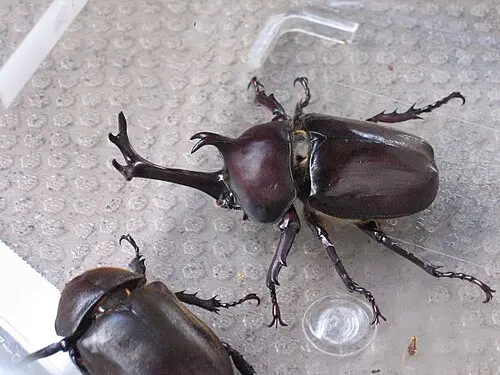
Photo: Gombe at Japanese Wikipedia · CC BY-SA 3.0 · Wikimedia Commons Source
Japanese rhinoceros beetle
Trypoxylus dichotomus (Japanese rhinoceros beetle · カブトムシ)
Not Evaluated (NE) on the IUCN Red List yet.
💡 Everyday Comparisons for Size, Mass & Speed
- 💡 A body length of 53 mm equals the length of two Korean 500-won coins (diameter 26.5 mm) placed side by side (Comparison).
- 💡 Korea's Rural Development Administration Cyber Insect Ecology Garden notes that although adults favor oak sap, because it is hard to obtain, they can be raised on insect jelly or sweet fruits such as bananas.
Reference standards: coach bus ~12 m, mid-size car ~4.9 m, compact car ~1 t, basketball hoop 3.05 m, credit card 8.56 cm.
📖 1. Overview
The Japanese rhinoceros beetle is a beetle in the family Scarabaeidae and an exceptionally large species among Korean scarab beetles. It lives throughout the Korean Peninsula and is also distributed in Japan and China.
🦴 2. Anatomy & Morphology
Its body is reddish-brown to blackish-brown. Males have glossy bodies and antler-shaped horns with forked tips on the head and pronotum, whereas females are matte, covered with short hairs, and have a short, stout tubercle instead of horns.
🔍 3. Ecology & Behavior
Adults are nocturnal, gathering at sap on oak and chestnut trees in midsummer and flying to lights. Larvae feed on decaying plant matter such as fallen leaves and rotting wood, overwinter, and pupate and emerge as adults in June–July of the following year.
🇰🇷 4. Connection to Korea
The 'Jangsupungdeng-i' (Korean name, listed as Allomyrina dichotoma) entry in the National List of Species of Korea notes that it inhabits the entire Korean Peninsula and requires approval for export abroad.
📚 Sources & References
- • IUCN Red List: not evaluated (NE) — cross-checked with the Wikidata conservation-status entry
- • catalogueoflife.org — 7CY6N
- • wikidata.org — Q1334311
- • commons.wikimedia.org — File:Kabutomushi-JapaneseBeetle-July2004.jpg
- • species.nibr.go.kr — mainHome.do
- • genebank.rda.go.kr — breedView.bo
- • Silhouette: PhyloPic — T. Michael Keesey · CC0 1.0
Recorded dimensions are widely cited representative estimates from public literature and may vary by study or specimen.