 📸 Photo
Photo: Diego Delso · CC BY-SA 4.0 · Wikimedia Commons Source
Secretarybird
Sagittarius serpentarius (Secretarybird · ヘビクイワシ)
💡 Everyday Comparisons for Size, Mass & Speed
- 💡 Its height of 1.2 m is about that of a lower-grade elementary school child, and its weight of 4.27 kg is less than half of a 10 kg bag of rice (Comparison).
- 💡 It is considered beneficial to farming because it catches crop-eating rodents and insects as well as snakes drawn to fields to prey on rodents (ADW 'Economic Importance for Humans: Positive').
Reference standards: coach bus ~12 m, mid-size car ~4.9 m, compact car ~1 t, basketball hoop 3.05 m, credit card 8.56 cm.
Site-computed relative index from recorded values; not a formal scientific metric.
📖 1. Overview
The Secretarybird is a large bird of prey with very long legs that hunts mainly on foot in short-grass savannas and grasslands. It is listed as Endangered (EN, 2020 assessment) on the IUCN Red List.
🦴 2. Anatomy & Morphology
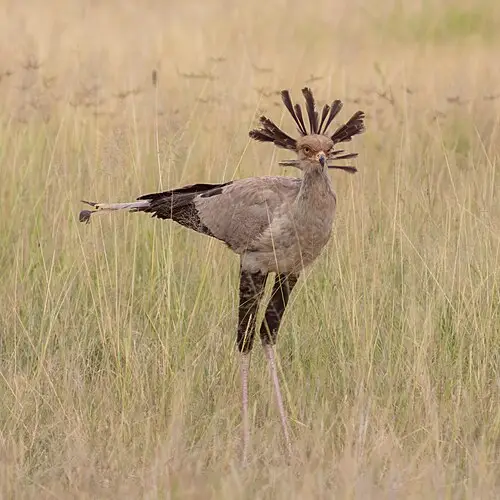
It stands 0.9–1.2 m tall and weighs 2.3–4.27 kg. Its body is mostly gray with black flight feathers, a crest of black-tipped feathers on the back of the head, and a bare orange-to-red face. It combines an eagle-like body with very long pinkish legs.
🔍 3. Ecology & Behavior
It feeds mainly on arthropods such as grasshoppers, beetles, and scorpions and small mammals such as rodents and hares, and although it catches snakes, it does not eat them as often as commonly believed. It hunts exclusively on the ground, walks 20–30 km a day, and is thought to pair for life.
🇰🇷 4. Connection to Korea
No direct record connecting this species to Korea has been found.
📚 Sources & References
- • IUCN Red List EN (2020) — https://www.iucnredlist.org/species/22696221/173647556
- • IUCN Red List category EN — latest assessment at iucnredlist.org
- • doi.org — avilist.v2026
- • iucnredlist.org — 173647556
- • wikidata.org — Q168748
- • commons.wikimedia.org — File:Secretario (Sagittarius serpentarius), parque nacional
- • animaldiversity.org — Sagittarius serpentarius
- • Silhouette: PhyloPic — Ferran Sayol · CC0 1.0
Recorded dimensions are widely cited representative estimates from public literature and may vary by study or specimen.