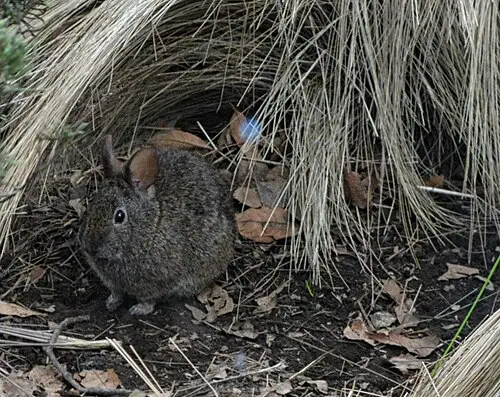
 📸 Photo
Photo: ProtoplasmaKid · CC BY-SA 4.0 · Wikimedia Commons Source
Volcano Rabbit
Romerolagus diazi (Volcano Rabbit · メキシコウサギ)
💡 Everyday Comparisons for Size, Mass & Speed
- 💡 Its maximum weight of 602.5 g is about 1.4 times heavier than a soccer ball (about 430 g) (Comparison).
- 💡 Its maximum length of 32 cm is slightly longer than the long side of an A4 sheet of paper (29.7 cm) (Comparison).
- 💡 In captivity, it eats chinchilla pellets, fruits, and vegetables along with grass.
Reference standards: coach bus ~12 m, mid-size car ~4.9 m, compact car ~1 t, basketball hoop 3.05 m, credit card 8.56 cm.
Site-computed relative index from recorded values; not a formal scientific metric.
📖 1. Overview
The Volcano Rabbit is a small rabbit living on the high slopes of Mexican volcanoes and is considered the most primitive living leporid.
🦴 2. Anatomy & Morphology
Its hind legs and feet are short, its ears are small and rounded, and its tail is vestigial. Its coat is yellowish-brown with black hair tips and bases, giving it a grizzled look.
🔍 3. Ecology & Behavior
It feeds mainly on zacatón grass along with young herbs and bark, and is most active at dawn and dusk. It lives in groups of 2–5 individuals, and usually only the highest-ranking male and female breed.
🇰🇷 4. Connection to Korea
No direct record connecting this species to Korea has been found.
📚 Sources & References
- • IUCN Red List EN (2019) — https://www.iucnredlist.org/species/19742/45180356
- • IUCN Red List category EN — latest assessment at iucnredlist.org
- • mammaldiversity.org — 1001120
- • iucnredlist.org — 45180356
- • wikidata.org — Q668030
- • commons.wikimedia.org — File:Romerolagus diazi - Zoologico de Chapultepec, Ciudad de
- • animaldiversity.org — Romerolagus diazi
- • Silhouette: PhyloPic — Bongopete (photograph) · CC BY 4.0 (Related taxon silhouette — Nesolagus netscheri)
Recorded dimensions are widely cited representative estimates from public literature and may vary by study or specimen.