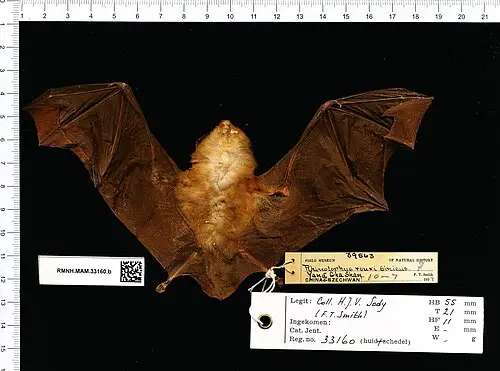
 📸 Photo
Photo: Public domain · CC0 · Wikimedia Commons Source
Chinese Rufous Horseshoe Bat
Rhinolophus sinicus (Chinese Rufous Horseshoe Bat · Chinese Rufous Horseshoe Bat)
💡 Everyday Comparisons for Size, Mass & Speed
- 💡 Its maximum forearm length of 5.15 cm is almost the same as the length of an AA battery (about 5 cm) (Comparison).
- 💡 Its maximum weight of 12.5 g is about one and a half Korean 500-won coins (about 7.7 g each) (Comparison).
- 💡 It is known from cave surveys in places such as Sichuan, China, where individuals were caught and measured directly.
Reference standards: coach bus ~12 m, mid-size car ~4.9 m, compact car ~1 t, basketball hoop 3.05 m, credit card 8.56 cm.
Site-computed relative index from recorded values; not a formal scientific metric.
📖 1. Overview
The Chinese Rufous Horseshoe Bat is a medium-sized horseshoe bat distributed across China and the Himalayan region that roosts in caves alongside other bats.
🦴 2. Anatomy & Morphology
In 13 individuals caught in China, forearm length was 44.8–51.5 mm and ear length was 15.8–21.0 mm. Its calls are long constant-frequency signals emitted through the noseleaf, with peak frequency at 80–88.2 kHz.
🔍 3. Ecology & Behavior
It often roosts in caves together with other bat species. Its diet and hunting habits remain largely unknown.
🇰🇷 4. Connection to Korea
No direct record connecting this species to Korea has been found.
📚 Sources & References
- • IUCN Red List LC (2019) — https://www.iucnredlist.org/species/41529/22005184
- • IUCN Red List category LC — latest assessment at iucnredlist.org
- • mammaldiversity.org — 1004746
- • iucnredlist.org — 22005184
- • wikidata.org — Q1767536
- • commons.wikimedia.org — File:Naturalis Biodiversity Center - RMNH.MAM.33160.b ven -
- • bio.bris.ac.uk — rhinolophussinicus.htm
- • Silhouette: PhyloPic — Margot Michaud · CC0 1.0 (Congeneric silhouette — Rhinolophus hipposideros)
Recorded dimensions are widely cited representative estimates from public literature and may vary by study or specimen.