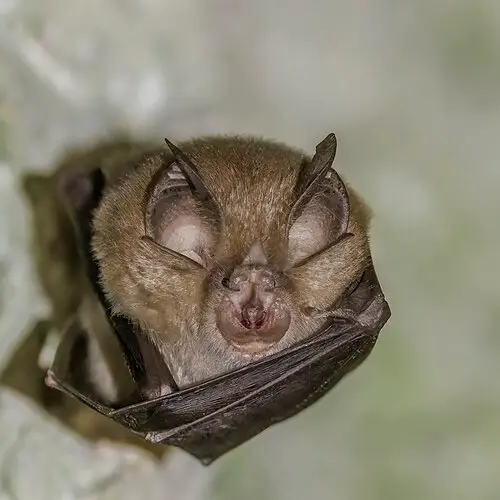
 📸 Photo
Photo: Charles J. Sharp · CC BY-SA 4.0 · Wikimedia Commons Source
Greater Horseshoe Bat
Rhinolophus ferrumequinum (Greater Horseshoe Bat · キクガシラコウモリ)
💡 Everyday Comparisons for Size, Mass & Speed
- 💡 Found in caves across the country, it preys on insect pests and helps reduce pest numbers.
- 💡 Its maximum weight of 34 g is just over four Korean 500-won coins (about 7.7 g each) (Comparison).
- 💡 Its maximum wingspan of 40 cm is about 2/3 of a 60 cm ruler (Comparison).
Reference standards: coach bus ~12 m, mid-size car ~4.9 m, compact car ~1 t, basketball hoop 3.05 m, credit card 8.56 cm.
Site-computed relative index from recorded values; not a formal scientific metric.
📖 1. Overview
The Greater Horseshoe Bat is the largest horseshoe bat in Europe and a common cave bat called "Gwanbakjwi" (Korean name) in Korea.
🦴 2. Anatomy & Morphology
Its most distinctive feature is its noseleaf, which is pointed at the top and horseshoe-shaped at the bottom. Its ears are large and translucent, and it lacks a tragus.
🔍 3. Ecology & Behavior
At dusk it flies low over the ground to catch large insects such as moths and beetles, using low-frequency ultrasound of 77–83 kHz. From October to April it hibernates hanging upside down wrapped in its wing membranes, and in June–July it gives birth to a single young.
🇰🇷 4. Connection to Korea
It is listed as "Gwanbakjwi" (Korean name) on the National List of Species of Korea and is distributed nationwide (including Jeju Island). Common in Korea, males and females hibernate separately in winter, and with a maximum lifespan of 30 years it is the longest-lived bat in Korea.
📚 Sources & References
- • IUCN Red List LC (2016) — https://www.iucnredlist.org/species/19517/21973253
- • IUCN Red List category LC — latest assessment at iucnredlist.org
- • mammaldiversity.org — 1004684
- • iucnredlist.org — 21973253
- • 국가생물종목록(국립생물자원관) ktsn 120000053253 — https://species.nibr.go.kr/home/mainHome.do?cont_link=009&subMenu=009002&contCd=009002&ktsn=120000053253
- • wikidata.org — Q737413
- • commons.wikimedia.org — File:Greater horseshoe bat (Rhinolophus ferrumequinum) Hrdov
- • animaldiversity.org — Rhinolophus ferrumequinum
- • species.nibr.go.kr — mainHome.do
- • Silhouette: PhyloPic — Margot Michaud · CC0 1.0 (Congeneric silhouette — Rhinolophus hipposideros)
Recorded dimensions are widely cited representative estimates from public literature and may vary by study or specimen.