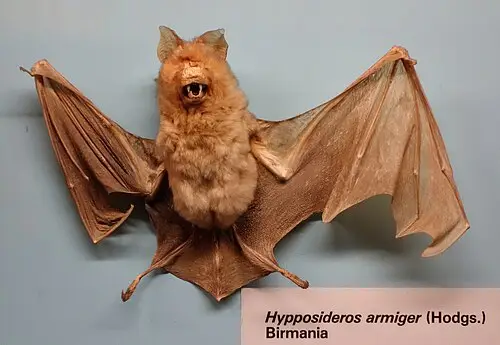
 📸 Photo
Photo: Daderot · CC0 · Wikimedia Commons Source
Great Himalayan Roundleaf Bat
Hipposideros armiger (Great Himalayan Roundleaf Bat · Great Himalayan Roundleaf Bat)
💡 Everyday Comparisons for Size, Mass & Speed
- 💡 Thousands of individuals were found gathered in a tunnel in Sichuan, and it shares roosts with other bats.
- 💡 Its maximum forearm length of 9.66 cm is slightly longer than the long side of a credit card (about 8.6 cm) (Comparison).
- 💡 Its maximum weight of 71.2 g is slightly heavier than an egg (about 60 g) (Comparison).
Reference standards: coach bus ~12 m, mid-size car ~4.9 m, compact car ~1 t, basketball hoop 3.05 m, credit card 8.56 cm.
Site-computed relative index from recorded values; not a formal scientific metric.
📖 1. Overview
The Great Himalayan Roundleaf Bat is a large roundleaf bat found in southern China, India, and Malaysia that roosts in caves during the day and eats insects.
🦴 2. Anatomy & Morphology
Its forearm measures 86.6–96.6 mm and its weight is 45–71.2 g. Its calls consist of a short constant-frequency signal with brief frequency modulation at both ends, peaking at 64.8–69.4 kHz (74.1 kHz in India).
🔍 3. Ecology & Behavior
It hunts in open woodland, gardens, and even under streetlights. In Meghalaya, India, beetles made up 56.3–100% of its winter-to-spring diet, and in Malaysia beetles (36.7%) and hymenopterans (28.8%) were also major prey.
🇰🇷 4. Connection to Korea
No direct record connecting this species to Korea has been found.
📚 Sources & References
- • IUCN Red List LC (2020) — https://www.iucnredlist.org/species/10110/22097743
- • IUCN Red List category LC — latest assessment at iucnredlist.org
- • mammaldiversity.org — 1004577
- • iucnredlist.org — 22097743
- • wikidata.org — Q307787
- • commons.wikimedia.org — File:Hipposideros armiger - Museo Civico di Storia Naturale
- • bio.bris.ac.uk — hipposiderosarmiger.htm
- • Silhouette: PhyloPic — author not recorded · CC0 1.0 (Related taxon silhouette — Asellia tridens)
Recorded dimensions are widely cited representative estimates from public literature and may vary by study or specimen.