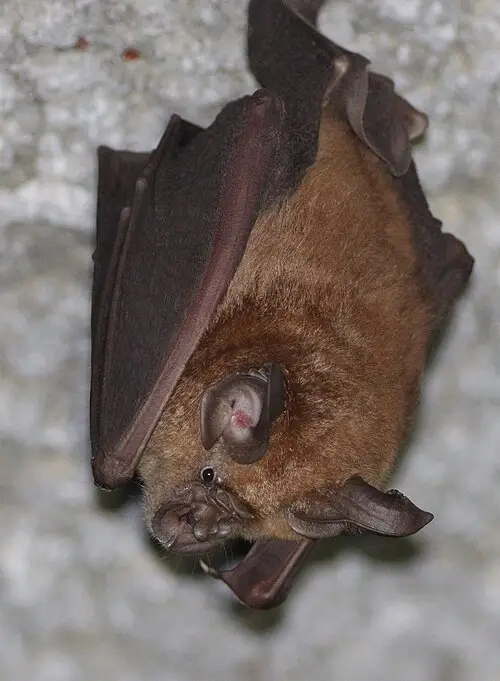
 📸 Photo
Photo: Jan Ebr & Ivana Ebrová · CC BY 4.0 · Wikimedia Commons Source
Greater Japanese Horseshoe Bat
Rhinolophus nippon (Greater Japanese Horseshoe Bat · Greater Japanese Horseshoe Bat)
Not Evaluated (NE) on the IUCN Red List yet.
💡 Everyday Comparisons for Size, Mass & Speed
- 💡 Its maximum head-and-body length of 7.9 cm is longer than the short side of a credit card (5.4 cm) and shorter than the long side (8.56 cm) (Comparison).
- 💡 Because it roosts in caves and under the roofs of disused buildings, colonies are sometimes found inside abandoned houses or old roofs, and cave tourism and building renovations are reported to threaten its roosts.
Reference standards: coach bus ~12 m, mid-size car ~4.9 m, compact car ~1 t, basketball hoop 3.05 m, credit card 8.56 cm.
📖 1. Overview
The Greater Japanese Horseshoe Bat is a species of horseshoe bat with a horseshoe-shaped skin structure around its nose, living in central and eastern China, the Korean Peninsula, and Japan.
🦴 2. Anatomy & Morphology
It is relatively large, with a head-and-body length of 55–79 mm and a forearm length of 49–64 mm. Its echolocation call frequency in Japan is 65–69.8 kHz.
🔍 3. Ecology & Behavior
It hunts by flying out from a perch on a branch or gleaning prey from the ground and leaves, feeding heavily on moths, beetles, and flies. It mates from late summer to early autumn, and females store sperm to give birth to a single young in early summer; a female living 23 years has been recorded in Japan.
🇰🇷 4. Connection to Korea
It is recorded as a species distributed on the Korean Peninsula (where the population belongs to the subspecies Rhinolophus nippon nippon).
📚 Sources & References
- • IUCN Red List: not evaluated (NE) — cross-checked with the Wikidata conservation-status entry
- • mammaldiversity.org — 1004722
- • 국가생물종목록(국립생물자원관) ktsn 120000053253 — https://species.nibr.go.kr/home/mainHome.do?cont_link=009&subMenu=009002&contCd=009002&ktsn=120000053253
- • wikidata.org — Q49550380
- • tb.plazi.org — 885887A2FFDD8A3AF896FB47F94CD195
- • Silhouette: PhyloPic — Margot Michaud · CC0 1.0 (Congeneric silhouette — Rhinolophus hipposideros)
Recorded dimensions are widely cited representative estimates from public literature and may vary by study or specimen.