 📸 Photo
Photo: Public domain · Public domain · Wikimedia Commons Source
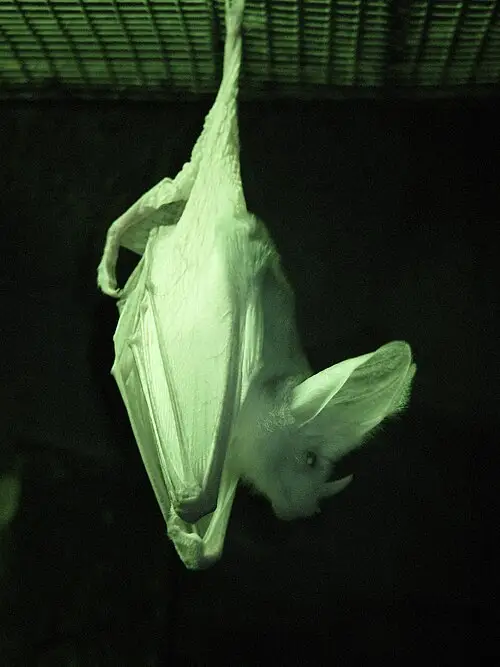
Ghost False-vampire
Macroderma gigas (Ghost False-vampire · ゴーストバット)
💡 Everyday Comparisons for Size, Mass & Speed
- 💡 It helps control rodents such as house mice by preying on them, and its droppings (guano) are used as fertilizer.
- 💡 Its maximum head-and-body length of 13 cm is slightly shorter than a ballpoint pen (about 14 cm) (Comparison).
- 💡 Its maximum weight of 170 g is slightly lighter than an apple (about 200 g) (Comparison).
Reference standards: coach bus ~12 m, mid-size car ~4.9 m, compact car ~1 t, basketball hoop 3.05 m, credit card 8.56 cm.
Site-computed relative index from recorded values; not a formal scientific metric.
📖 1. Overview
The Ghost False-vampire is Australia's only carnivorous bat, called the ghost bat because of its almost white coloring.
🦴 2. Anatomy & Morphology
Individuals in the Pilbara have an ashy-gray back and white belly, while northern individuals are dark sooty-gray. Its large, long ears are joined at the base, and its forearm measures 10.2–11.2 cm.
🔍 3. Ecology & Behavior
It feeds on large insects, reptiles, frogs, birds, small mammals, and other bats, dropping from above to wrap prey in its wing membranes before biting the head and neck. It mates in July–August and gives birth to a single young in September–November after about 3 months of gestation.
🇰🇷 4. Connection to Korea
No direct record connecting this species to Korea has been found.
📚 Sources & References
- • IUCN Red List VU (2021) — https://www.iucnredlist.org/species/12590/209530568
- • IUCN Red List category VU — latest assessment at iucnredlist.org
- • mammaldiversity.org — 1004649
- • iucnredlist.org — 209530568
- • wikidata.org — Q301371
- • commons.wikimedia.org — File:Ghost bat infrared Perth zoo.jpg
- • animaldiversity.org — Macroderma gigas
- • Silhouette: PhyloPic — Margot Michaud · CC0 1.0
Recorded dimensions are widely cited representative estimates from public literature and may vary by study or specimen.