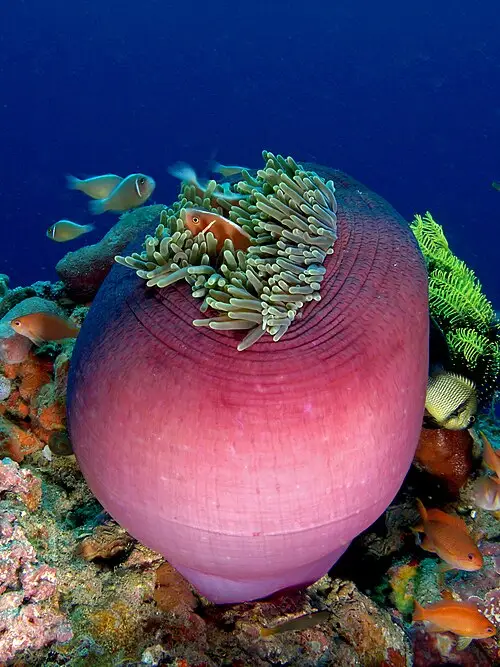
 📸 Photo
Photo: Nhobgood Nick Hobgood · CC BY-SA 3.0 · Wikimedia Commons Source
Magnificent sea anemone
Radianthus magnifica (Magnificent sea anemone · Magnificent sea anemone)
Not Evaluated (NE) on the IUCN Red List yet.
💡 Everyday Comparisons for Size, Mass & Speed
- 💡 Its maximum oral disc diameter of about 1 m is a little over half the arm span of an adult human (Comparison).
- 💡 It is the most photographed sea anemone and is popular in ornamental aquariums, with clownfish living among its tentacles (ADW).
Reference standards: coach bus ~12 m, mid-size car ~4.9 m, compact car ~1 t, basketball hoop 3.05 m, credit card 8.56 cm.
📖 1. Overview
The magnificent sea anemone (also called Heteractis magnifica) is a large sea anemone living attached to coral reefs and serving as a home where clownfish live among its tentacles.
🦴 2. Anatomy & Morphology
Its column-shaped body has a sticky pedal disc, and its oral disc is usually 30–50 cm in diameter and surrounded by finger-like tentacles with swollen tips.
🔍 3. Ecology & Behavior
It catches small fish, shrimp, and plankton using tentacles armed with stinging cells, also uses sugars produced by symbiotic algae inside its body, and lives in mutualistic symbiosis with clownfish.
🇰🇷 4. Connection to Korea
No direct record connecting this species to Korea has been found.
📚 Sources & References
- • IUCN Red List: not evaluated (NE) — cross-checked with the Wikidata conservation-status entry
- • marinespecies.org — aphia.php
- • wikidata.org — Q105888748
- • commons.wikimedia.org — File:Amphiprion perideraion (Pink anemonefish) in Heteractis
- • animaldiversity.org — Heteractis magnifica
Recorded dimensions are widely cited representative estimates from public literature and may vary by study or specimen.