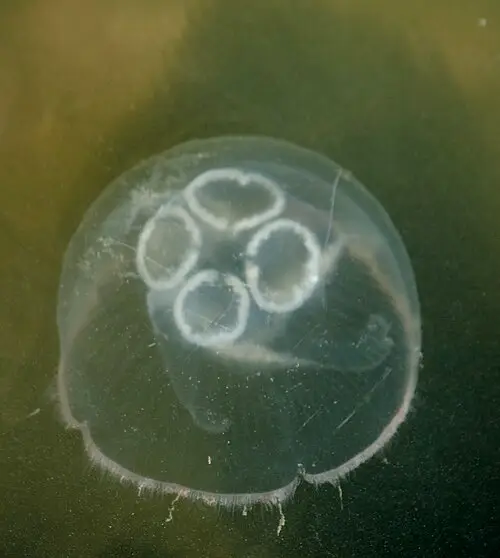
 📸 Photo
Photo: Paul VanDerWerf from Brunswick, Maine, USA · CC BY 2.0 · Wikimedia Commons Source
Moon jellyfish
Aurelia aurita (Moon jellyfish · ミズクラゲ)
Not Evaluated (NE) on the IUCN Red List yet.
💡 Everyday Comparisons for Size, Mass & Speed
- 💡 A bell diameter of 35 cm is slightly larger than the long side of an A4 sheet of paper (29.7 cm) (Comparison).
- 💡 When mass blooms occur in Korean waters in summer, the Ministry of Oceans and Fisheries issues advisory alerts, as it is known to interfere with fishers' net operations (2024 press release).
Reference standards: coach bus ~12 m, mid-size car ~4.9 m, compact car ~1 t, basketball hoop 3.05 m, credit card 8.56 cm.
📖 1. Overview
The moon jellyfish is a round, transparent jellyfish living in coastal waters worldwide, with four horseshoe-shaped bluish gonads visible inside its bell.
🦴 2. Anatomy & Morphology
Its transparent bell is 10–35 cm in diameter, with 4 oral arms beneath it and short tentacles 1–5 cm long along the bell margin.
🔍 3. Ecology & Behavior
It feeds on plankton, copepods, bivalve eggs, fish eggs, and small jellyfish caught on its bell and tentacles, and larvae (ephyrae) that bud off from polyps grow into adult medusae.
🇰🇷 4. Connection to Korea
A jellyfish native to Korea, its venom is mild, but mass blooms damage fishing gear and disrupt fishing operations; Korea's Ministry of Oceans and Fisheries issues an advisory-level alert at a threshold of 5 adults per 100 ㎡.
📚 Sources & References
- • IUCN Red List: not evaluated (NE) — cross-checked with the Wikidata conservation-status entry
- • marinespecies.org — aphia.php
- • 국가생물종목록(국립생물자원관) ktsn 120000039680 — https://species.nibr.go.kr/home/mainHome.do?cont_link=009&subMenu=009002&contCd=009002&ktsn=120000039680
- • wikidata.org — Q26864
- • commons.wikimedia.org — File:Moon Jellyfish (14278816210).jpg
- • animaldiversity.org — Aurelia aurita
- • mof.go.kr — selectDoc.do
- • Silhouette: PhyloPic — author not recorded · CC0 1.0
Recorded dimensions are widely cited representative estimates from public literature and may vary by study or specimen.