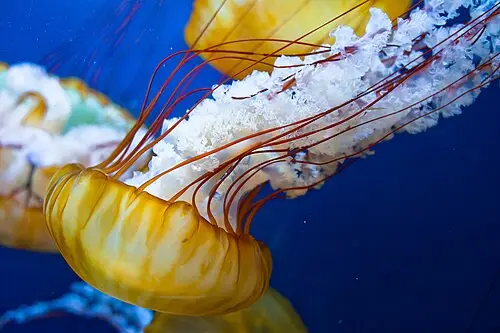
 📸 Photo
Photo: Kenny Louie from Vancouver, Canada · CC BY 2.0 · Wikimedia Commons Source
Japanese sea nettle
Chrysaora pacifica (Japanese sea nettle · アカクラゲ)
Not Evaluated (NE) on the IUCN Red List yet.
💡 Everyday Comparisons for Size, Mass & Speed
- 💡 A bell width of 12 inches (about 30 cm) is the same length as a single 30 cm ruler (Comparison).
- 💡 In large individuals whose tentacles grow up to 10 feet (about 3 m), the tentacles are about 1.7 times the width of a passenger car (about 1.8 m) (Comparison).
- 💡 A sting can cause an allergic reaction (National Aquarium, USA).
Reference standards: coach bus ~12 m, mid-size car ~4.9 m, compact car ~1 t, basketball hoop 3.05 m, credit card 8.56 cm.
📖 1. Overview
The Japanese sea nettle is a stinging jellyfish living in the Pacific near Japan. Its bell ranges from transparent to brownish-orange with dark lines running from top to bottom.
🦴 2. Anatomy & Morphology
Its bell width reaches up to 12 inches (about 30 cm), and the tentacles of large individuals grow up to 10 feet (about 3 m). Dark stripes run vertically down the bell.
🔍 3. Ecology & Behavior
It feeds on zooplankton such as small crustaceans and other jellyfish. Although its venom is not considered very strong, stings can cause allergic reactions in some people.
🇰🇷 4. Connection to Korea
It is listed as 'Keoteun-wonyanghaepari' (Korean name) in the National List of Species of Korea.
📚 Sources & References
- • IUCN Red List: not evaluated (NE) — cross-checked with the Wikidata conservation-status entry
- • marinespecies.org — aphia.php
- • 국가생물종목록(국립생물자원관) ktsn 120000212002 — https://species.nibr.go.kr/home/mainHome.do?cont_link=009&subMenu=009002&contCd=009002&ktsn=120000212002
- • wikidata.org — Q3997154
- • commons.wikimedia.org — File:Japanese Sea-Nettle (5688888862).jpg
- • aqua.org — japanese-sea-nettle
- • sealifebase.se — Chrysaora-pacifica.html
- • Silhouette: PhyloPic — Levi Simons and Kurtis Wothe · CC0 1.0 (Congeneric silhouette — Chrysaora)
Recorded dimensions are widely cited representative estimates from public literature and may vary by study or specimen.