 📸 Photo
Photo: Esculapio · CC BY-SA 3.0 · Wikimedia Commons Source
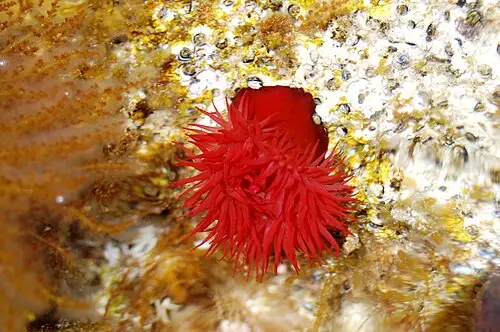
Beadlet anemone
Actinia equina (Beadlet anemone · ウメボシイソギンチャク)
Not Evaluated (NE) on the IUCN Red List yet.
💡 Everyday Comparisons for Size, Mass & Speed
- 💡 Its body column diameter of 3–4 cm is slightly larger than the diameter of a Korean 500-won coin (about 2.65 cm) (Comparison).
- 💡 Its average dry weight of 0.42 g is about 1/140 the weight of a single chicken egg (about 60 g) (Comparison).
- 💡 Substances produced by cells inside its body have antibacterial properties and are being studied for potential use in medicine or plant protection (ADW).
Reference standards: coach bus ~12 m, mid-size car ~4.9 m, compact car ~1 t, basketball hoop 3.05 m, credit card 8.56 cm.
Site-computed relative index from recorded values; not a formal scientific metric.
📖 1. Overview
The beadlet anemone is a red sea anemone living in clusters in rocky tide pools along the seashore. Out of the water, it retracts its tentacles and looks like a small red blob.
🦴 2. Anatomy & Morphology
Its body is divided into tentacles, a body column, and a wide pedal disc that attaches to rocks. It has up to 192 tentacles with wart-like blue spots beneath them; body color varies from green to red, with reddish-brown being most common.
🔍 3. Ecology & Behavior
Using nematocysts (stinging cells) on its tentacles, it paralyzes and eats almost anything it can catch, including bivalves, insects, and crustaceans. It is the only sea anemone known to brood its young inside its body before giving birth, and it also reproduces by dividing its body.
🇰🇷 4. Connection to Korea
It is listed in the National List of Species of Korea, living mainly along the South Sea coast and occasionally found along the East Sea coast. It has been recorded from Jeju Island (Seogwipo, Marado), Mipo, Dangsa, Hongdo, Sohwado, and Dokdo.
📚 Sources & References
- • IUCN Red List: not evaluated (NE) — cross-checked with the Wikidata conservation-status entry
- • marinespecies.org — aphia.php
- • 국가생물종목록(국립생물자원관) ktsn 120000039799 — https://species.nibr.go.kr/home/mainHome.do?cont_link=009&subMenu=009002&contCd=009002&ktsn=120000039799
- • wikidata.org — Q580826
- • commons.wikimedia.org — File:Actinia equina 0009.JPG
- • species.nibr.go.kr — mainHome.do
- • sealifebase.se — Actinia-equina.html
- • animaldiversity.org — Actinia equina
- • Silhouette: PhyloPic — author not recorded · CC0 1.0
Recorded dimensions are widely cited representative estimates from public literature and may vary by study or specimen.