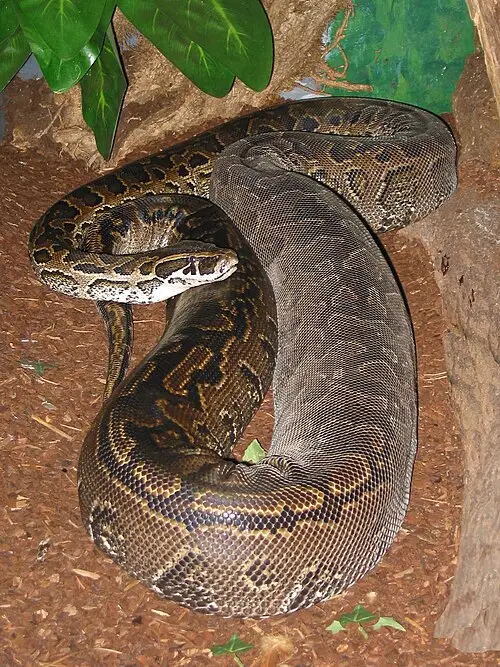
 📸 Photo
Photo: Adult_Female_Python_sebae.jpg : Tigerpython derivative work: Materialscientist ( talk ) · CC BY-SA 3.0 · Wikimedia Commons Source
African Rock Python
Python sebae (African Rock Python · アフリカニシキヘビ)
💡 Everyday Comparisons for Size, Mass & Speed
- 💡 A maximum length of 7.5 m is longer than one and a half passenger cars (about 4.5 m each), and a maximum weight of 91 kg is about the weight of an adult human (Comparison).
- 💡 Animal Diversity Web cites its skin and meat as its most lucrative uses, noting about 9,300 skins exported in 2002, and adds that when living near people it also preys on livestock and pets.
Reference standards: coach bus ~12 m, mid-size car ~4.9 m, compact car ~1 t, basketball hoop 3.05 m, credit card 8.56 cm.
Site-computed relative index from recorded values; not a formal scientific metric.
📖 1. Overview
The African Rock Python is the largest snake in Africa, averaging 3–5 m in length and living in forests and savannas near rivers and lakes.
🦴 2. Anatomy & Morphology
Its relatively small triangular head is covered in irregular blackish to brownish-gray scales and bears two light bands forming a spearhead shape. Newly hatched young measure about 35–45 cm.
🔍 3. Ecology & Behavior
Juveniles eat small mammals, while adults eat large prey such as monkeys, crocodiles, large lizards, and antelope, locating prey at twilight with heat-sensing pits. It breeds in months 11–3, and neither males nor females feed during the mating season.
🇰🇷 4. Connection to Korea
No direct record connecting this species to Korea has been found.
📚 Sources & References
- • IUCN Red List NT (2021) — https://www.iucnredlist.org/species/13300572/13300582
- • IUCN Red List category NT — latest assessment at iucnredlist.org
- • catalogueoflife.org — 4QY54
- • iucnredlist.org — 13300582
- • wikidata.org — Q764797
- • commons.wikimedia.org — File:Adult Female Python sebae 1.33aspect.jpg
- • animaldiversity.org — Python sebae
- • Silhouette: PhyloPic — DS Biswas · CC BY 4.0 (Congeneric silhouette — Python bivittatus)
Recorded dimensions are widely cited representative estimates from public literature and may vary by study or specimen.