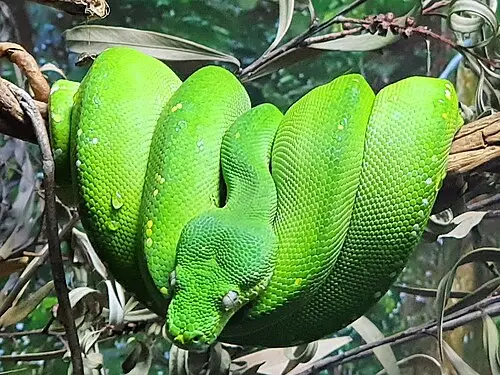
 📸 Photo
Photo: TarnishedPath · CC BY-SA 4.0 · Wikimedia Commons Source
Green Tree Python
Morelia viridis (Green Tree Python · ミドリニシキヘビ)
💡 Everyday Comparisons for Size, Mass & Speed
- 💡 Its maximum length of 2.2 m is slightly longer than the height of a room door (about 2 m) (Comparison).
- 💡 Animal Diversity Web notes that because the Green Tree Python is one of the most popular snakes in the pet trade, Indonesia exports captive-bred individuals each year, and the Smithsonian's National Zoo notes that it feeds its Green Tree Pythons rats and mice.
Reference standards: coach bus ~12 m, mid-size car ~4.9 m, compact car ~1 t, basketball hoop 3.05 m, credit card 8.56 cm.
📖 1. Overview
The Green Tree Python is a python living in tropical rainforests of New Guinea and northeastern Australia, and is the most arboreal of all pythons.
🦴 2. Anatomy & Morphology
Its head scales are small and irregular, heat-sensing pits are present only on the upper lip scales, and its tail is prehensile. Adults are bright green with a line of white or yellow scales along the back, while juveniles are yellow, red, or reddish-brown before turning green at about 6–12 months of age.
🔍 3. Ecology & Behavior
Resting coiled over tree branches, it ambushes small reptiles, invertebrates, mammals, and birds, and sometimes wiggles its tail to lure prey. Adults are active at night and juveniles by day, with their diets shifting accordingly.
🇰🇷 4. Connection to Korea
No direct record connecting this species to Korea has been found.
📚 Sources & References
- • IUCN Red List LC (2018) — https://www.iucnredlist.org/species/177524/21649845
- • IUCN Red List category LC — latest assessment at iucnredlist.org
- • catalogueoflife.org — 44CWG
- • iucnredlist.org — 21649845
- • wikidata.org — Q849394
- • commons.wikimedia.org — File:M. viridis.jpg
- • animaldiversity.org — Morelia viridis
- • nationalzoo.si.edu — green-tree-python
- • Silhouette: PhyloPic — DS Biswas · CC BY 4.0 (Related taxon silhouette — Python bivittatus)
Recorded dimensions are widely cited representative estimates from public literature and may vary by study or specimen.