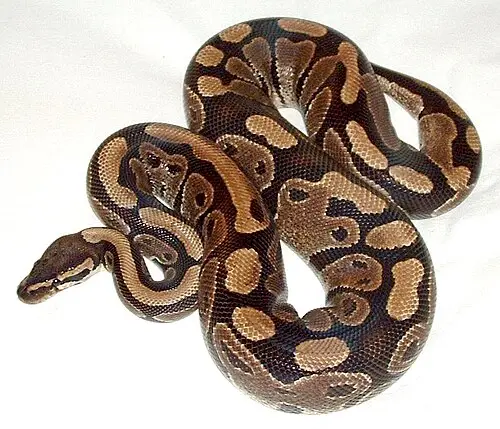
 📸 Photo
Photo: HCA ( talk ) · CC BY-SA 3.0 · Wikimedia Commons Source
Ball Python
Python regius (Ball Python · ボールニシキヘビ)
💡 Everyday Comparisons for Size, Mass & Speed
- 💡 A maximum length of 1.83 m is similar to an adult human's height (Comparison).
- 💡 Animal Diversity Web notes that the Ball Python provides millions of dollars in annual benefits to rural West and Central Africa by controlling rodents, and is revered as sacred and protected in some regions.
Reference standards: coach bus ~12 m, mid-size car ~4.9 m, compact car ~1 t, basketball hoop 3.05 m, credit card 8.56 cm.
📖 1. Overview
The Ball Python is a heavy-bodied python living in African savannas, named after its habit of curling into a tight ball when threatened.
🦴 2. Anatomy & Morphology
Its head is larger than its slender neck and its body is stout, with lighter brown spots interspersed between large brown markings. Some individuals have yellow stripes running from the nostrils through the eyes, the belly is mostly ivory, and adult females are larger than males.
🔍 3. Ecology & Behavior
It spends most of its time on the ground or in burrows, is most active at dawn and dusk, and ambushes rodents such as rats almost exclusively. The female lays 1–11 eggs and coils around them to guard them for about two months.
🇰🇷 4. Connection to Korea
No direct record connecting this species to Korea has been found.
📚 Sources & References
- • IUCN Red List NT (2022) — https://www.iucnredlist.org/species/177562/220378972
- • IUCN Red List category NT — latest assessment at iucnredlist.org
- • catalogueoflife.org — 7925W
- • iucnredlist.org — 220378972
- • wikidata.org — Q464424
- • commons.wikimedia.org — File:Ball python lucy.JPG
- • animaldiversity.org — Python regius
- • Silhouette: PhyloPic — DS Biswas · CC BY 4.0 (Congeneric silhouette — Python bivittatus)
Recorded dimensions are widely cited representative estimates from public literature and may vary by study or specimen.