 📸 Photo
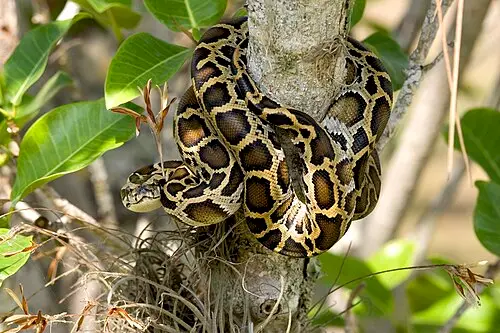
Photo: Everglades NPS from Homestead, Florida, United States · Public domain · Wikimedia Commons Source
Burmese Python
Python bivittatus (Burmese Python · ビルマニシキヘビ)
💡 Everyday Comparisons for Size, Mass & Speed
- 💡 A maximum length of 7.6 m is about 3/4 the length of a city bus (about 10 m) (Comparison).
- 💡 The Smithsonian explains that in southern Florida in the United States, introduced individuals have bred and threaten native wildlife and ecosystems.
Reference standards: coach bus ~12 m, mid-size car ~4.9 m, compact car ~1 t, basketball hoop 3.05 m, credit card 8.56 cm.
Site-computed relative index from recorded values; not a formal scientific metric.
📖 1. Overview
The Burmese Python is a large snake living from southern China across Southeast Asia, and has become a problematic invasive species in Florida in the United States.
🦴 2. Anatomy & Morphology
It usually measures 3–4.9 m long, with individuals over 4.6 m common, and has been recorded up to 7.6 m and 137 kg. It locates prey using scent and heat-sensing pits.
🔍 3. Ecology & Behavior
It mainly catches mammals such as rodents, and also eats birds, amphibians, reptiles, and carrion. The female lays up to 100 eggs and coils around them, shivering her muscles to warm them.
🇰🇷 4. Connection to Korea
No direct record connecting this species to Korea has been found.
📚 Sources & References
- • IUCN Red List VU (2012) — https://www.iucnredlist.org/species/193451/151341916
- • IUCN Red List category VU — latest assessment at iucnredlist.org
- • catalogueoflife.org — 4QY48
- • iucnredlist.org — 151341916
- • wikidata.org — Q2716137
- • commons.wikimedia.org — File:Burmese Python (13), NPSPhoto, R. Cammauf (9101584016).
- • animaldiversity.org — Python molurus
- • nationalzoo.si.edu — burmese-python
- • Silhouette: PhyloPic — DS Biswas · CC BY 4.0 (Congeneric silhouette — Python bivittatus)
Recorded dimensions are widely cited representative estimates from public literature and may vary by study or specimen.