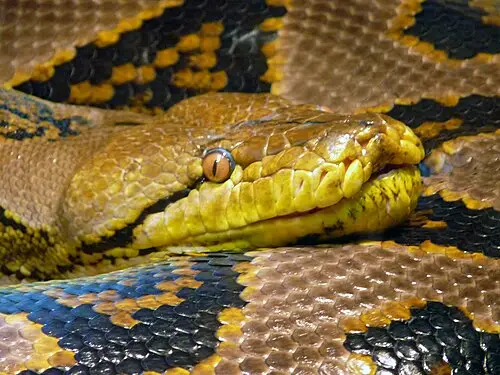
 📸 Photo
Photo: Goalsurfer · CC BY-SA 3.0 · Wikimedia Commons Source
Reticulated Python
Malayopython reticulatus (Reticulated Python · アミメニシキヘビ)
💡 Everyday Comparisons for Size, Mass & Speed
- 💡 Its maximum length of 9 m is close to the length of a city bus (about 10–12 m) (Comparison).
- 💡 Singapore's National Parks Board notes that in urban areas this snake travels through storm drains and swims along canals.
Reference standards: coach bus ~12 m, mid-size car ~4.9 m, compact car ~1 t, basketball hoop 3.05 m, credit card 8.56 cm.
Site-computed relative index from recorded values; not a formal scientific metric.
📖 1. Overview
The Reticulated Python is a python living in Southeast Asia, known as the longest snake in the world and also found in urban areas.
🦴 2. Anatomy & Morphology
Geometric black markings interconnect in a net-like pattern over a pale yellow to brown background, giving it the name "reticulatus" (net-like). Females are much larger than males, and its scales shimmer with an iridescent sheen in sunlight.
🔍 3. Ecology & Behavior
Using heat-sensing organs to locate prey, it eats mammals and birds ranging from bats, treeshrews, and deer even to Sun Bears. In Singapore, where large prey is scarce, it feeds mainly on small mammals such as rats, and lays 15–80 eggs at a time that hatch after about 88 days.
🇰🇷 4. Connection to Korea
No direct record connecting this species to Korea has been found.
📚 Sources & References
- • IUCN Red List LC (2018) — https://www.iucnredlist.org/species/183151/1730027
- • IUCN Red List category LC — latest assessment at iucnredlist.org
- • catalogueoflife.org — 3XMDC
- • iucnredlist.org — 1730027
- • wikidata.org — Q216136
- • commons.wikimedia.org — File:Python reticulatus kop.jpg
- • animaldiversity.org — Python reticulatus
- • biodiversitysg.nparks.gov.sg — reticulated-python
- • nparks.gov.sg — 6449
- • Silhouette: PhyloPic — DS Biswas · CC BY 4.0 (Related taxon silhouette — Python bivittatus)
Recorded dimensions are widely cited representative estimates from public literature and may vary by study or specimen.