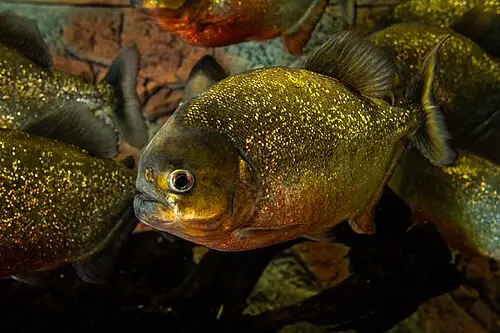
 📸 Photo
Photo: Mattia Nocciola · CC BY-SA 4.0 · Wikimedia Commons Source
Red piranha
Pygocentrus nattereri (Red piranha · ピラニア・ナッテリー)
💡 Everyday Comparisons for Size, Mass & Speed
- 💡 It is commonly traded as an aquarium fish and caught in local fisheries and angling; its flesh has been analyzed at 15% protein and 8.2% fat.
- 💡 A body length of 50 cm is about 1.7 times the long side of an A4 sheet of paper (29.7 cm) (Comparison). Its maximum weight of 3.9 kg is similar to a 4 kg bag of rice (Comparison).
Reference standards: coach bus ~12 m, mid-size car ~4.9 m, compact car ~1 t, basketball hoop 3.05 m, credit card 8.56 cm.
Site-computed relative index from recorded values; not a formal scientific metric.
📖 1. Overview
The red piranha is a carnivorous fish living in South American rivers, famous for its sharp teeth.
🦴 2. Anatomy & Morphology
Its body is deep and laterally flattened, with powerful teeth. The teeth on the left and right sides of the jaws are replaced alternately so it can keep biting prey.
🔍 3. Ecology & Behavior
It mainly eats insects, worms, and fish at dawn and dusk, and there is a hierarchy within its small schools. Eggs are attached to submerged tree roots and hatch in 9–10 days.
🇰🇷 4. Connection to Korea
No direct record connecting this species to Korea has been found.
📚 Sources & References
- • IUCN Red List LC (2024) — https://www.iucnredlist.org/species/186604/1815617
- • IUCN Red List category LC — latest assessment at iucnredlist.org
- • catalogueoflife.org — 4QP42
- • iucnredlist.org — 1815617
- • wikidata.org — Q928382
- • commons.wikimedia.org — File:Pygocentrus nattereri Natural History Museum University
- • fishbase.se — Pygocentrus-nattereri.html
- • Silhouette: PhyloPic — Andy Wilson · CC0 1.0 (Related taxon silhouette — Metynnis)
Recorded dimensions are widely cited representative estimates from public literature and may vary by study or specimen.