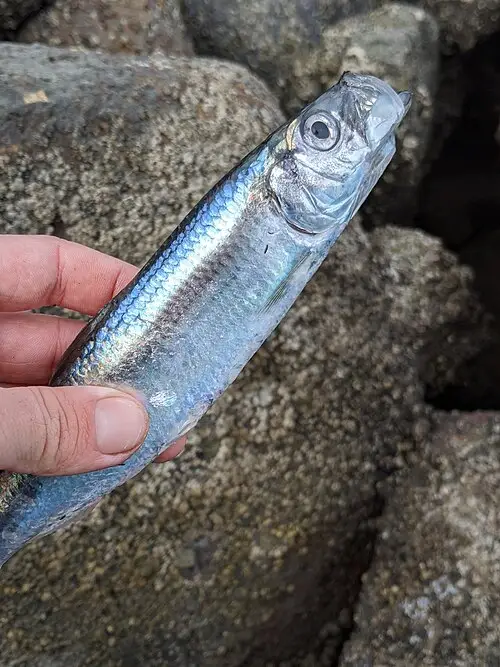
 📸 Photo
Photo: arheyman01 · CC0 · Wikimedia Commons Source
Pacific herring
Clupea pallasii (Pacific herring · タイヘイヨウニシン)
💡 Everyday Comparisons for Size, Mass & Speed
- 💡 Its maximum total length of 46 cm is the length of one and a half 30 cm rulers (Comparison).
- 💡 The weight of northeastern Pacific individuals, 0.27 kg, is the weight of four or five eggs (about 60 g each) (Comparison).
- 💡 It is a heavily fished commercial species and is also commonly used as fishing bait (FishBase).
- 💡 In Korea, it can be seen in the East Sea (National List of Species of Korea).
Reference standards: coach bus ~12 m, mid-size car ~4.9 m, compact car ~1 t, basketball hoop 3.05 m, credit card 8.56 cm.
Site-computed relative index from recorded values; not a formal scientific metric.
📖 1. Overview
The Pacific herring is a schooling marine fish of the North Pacific that mainly lives in the East Sea in Korea. Its back is dark blue and its belly is silvery white.
🦴 2. Anatomy & Morphology
Its body is somewhat flattened from side to side with a slightly pointed snout, eyelids over the eyes, and scales that come off very easily. Its dorsal fin sits near the middle of the body.
🔍 3. Ecology & Behavior
From March to May, it moves into bays or estuaries and attaches its eggs to seaweeds. Juveniles school in shallow bays during the summer before moving to deeper waters in the fall to stay for 2–3 years, and adults feed on large crustaceans and small fishes.
🇰🇷 4. Connection to Korea
It is listed on the National List of Species of Korea and mainly lives in the East Sea in Korea.
📚 Sources & References
- • IUCN Red List DD (2019) — https://www.iucnredlist.org/species/98471199/98845541
- • IUCN Red List category DD — latest assessment at iucnredlist.org
- • catalogueoflife.org — WCTM
- • iucnredlist.org — 98845541
- • 국가생물종목록(국립생물자원관) ktsn 120000057500 — https://species.nibr.go.kr/home/mainHome.do?cont_link=009&subMenu=009002&contCd=009002&ktsn=120000057500
- • wikidata.org — Q1510347
- • commons.wikimedia.org — File:Clupea pallasii CA.jpg
- • fishbase.se — Clupea-pallasii.html
- • fisheries.noaa.gov — pacific-herring
- • species.nibr.go.kr — mainHome.do
- • Silhouette: PhyloPic — xgirouxb · Public Domain Mark 1.0
Recorded dimensions are widely cited representative estimates from public literature and may vary by study or specimen.