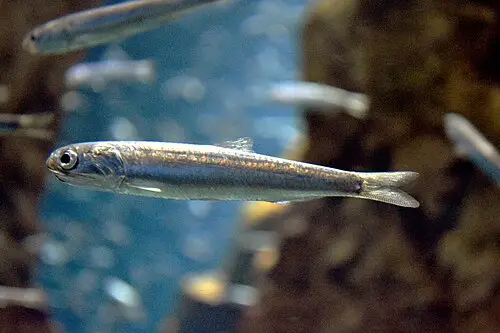
 📸 Photo
Photo: Kingfisher · CC BY-SA 4.0 · Wikimedia Commons Source
Japanese anchovy
Engraulis japonicus (Japanese anchovy · カタクチイワシ)
💡 Everyday Comparisons for Size, Mass & Speed
- 💡 Its maximum total length of 18 cm is similar to a pencil (about 17.5 cm) (Comparison).
- 💡 Its maximum weight of 45 g is lighter than a single egg (about 60 g) (Comparison).
- 💡 It is sold fresh or salted, and is also processed into fishmeal and oil (FishBase).
- 💡 It is also commonly used as fishing bait (FishBase).
Reference standards: coach bus ~12 m, mid-size car ~4.9 m, compact car ~1 t, basketball hoop 3.05 m, credit card 8.56 cm.
Site-computed relative index from recorded values; not a formal scientific metric.
📖 1. Overview
The Japanese anchovy is a small fish living in large schools in the surface waters of seas around Japan, Taiwan, China, and Korea. Its back is dark blue and its belly is silvery white.
🦴 2. Anatomy & Morphology
Its body is long and cylindrical, with a smooth belly outline lacking sharp scutes. Its upper jaw projects beyond the lower jaw over a large mouth, and a blue longitudinal stripe runs along its side.
🔍 3. Ecology & Behavior
It feeds on plankton and swims in schools near the sea surface. It spawns floating eggs in continental shelf waters around March to July, and is generally known to live for one year.
🇰🇷 4. Connection to Korea
It is listed on the National List of Species of Korea, is seen along all coasts of Korea, and is especially abundant off the West and South coasts.
📚 Sources & References
- • IUCN Red List LC (2018) — https://www.iucnredlist.org/species/98969433/143841777
- • IUCN Red List category LC — latest assessment at iucnredlist.org
- • catalogueoflife.org — 6F994
- • iucnredlist.org — 143841777
- • 국가생물종목록(국립생물자원관) ktsn 120000057486 — https://species.nibr.go.kr/home/mainHome.do?cont_link=009&subMenu=009002&contCd=009002&ktsn=120000057486
- • wikidata.org — Q516676
- • commons.wikimedia.org — File:Engraulis japonicus 01.JPG
- • fishbase.se — Engraulis-japonicus.html
- • species.nibr.go.kr — mainHome.do
- • Silhouette: PhyloPic — Juan Carlos Jerí · CC0 1.0 (Congeneric silhouette — Engraulis ringens)
Recorded dimensions are widely cited representative estimates from public literature and may vary by study or specimen.