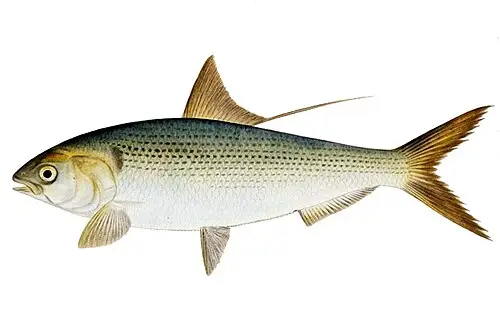
 📸 Photo
Photo: (Temminck and Schlegel) · Public domain · Wikimedia Commons Source
Dotted gizzard shad
Konosirus punctatus (Dotted gizzard shad · コノシロ)
💡 Everyday Comparisons for Size, Mass & Speed
- 💡 Its maximum total length of 32 cm is 2 cm longer than a 30 cm ruler (Comparison).
- 💡 It can be seen along all coasts of Korea and enters river estuaries (National List of Species of Korea).
- 💡 FishBase classifies it as a species caught in small-scale commercial fisheries.
Reference standards: coach bus ~12 m, mid-size car ~4.9 m, compact car ~1 t, basketball hoop 3.05 m, credit card 8.56 cm.
📖 1. Overview
The dotted gizzard shad is a herring-like fish that lives in schools along the coast and enters river estuaries. It also occurs in Japan and the East and South China Seas.
🦴 2. Anatomy & Morphology
Its body is laterally compressed, dark bluish on the back and silvery-white on the belly. The last soft ray of the dorsal fin is elongated into a filament, and there is a single black spot behind the gill cover.
🔍 3. Ecology & Behavior
It lays buoyant pelagic eggs in spring. In Japan's Ariake Sea, it moves into shallow brackish waters in April and May to spawn, and appears to spawn twice or more in a single season.
🇰🇷 4. Connection to Korea
It is listed in the National List of Species of Korea and distributed along all coasts of Korea.
📚 Sources & References
- • IUCN Red List LC (2017) — https://www.iucnredlist.org/species/75153576/75153604
- • IUCN Red List category LC — latest assessment at iucnredlist.org
- • catalogueoflife.org — 6NMT7
- • iucnredlist.org — 75153604
- • 국가생물종목록(국립생물자원관) ktsn 120000057504 — https://species.nibr.go.kr/home/mainHome.do?cont_link=009&subMenu=009002&contCd=009002&ktsn=120000057504
- • wikidata.org — Q1065067
- • commons.wikimedia.org — File:Konosirus punctatus2.jpeg
- • fishbase.se — Konosirus-punctatus.html
- • species.nibr.go.kr — mainHome.do
- • Silhouette: PhyloPic — author not recorded · Public Domain Mark 1.0 (Related taxon silhouette — Ophisthonema oglinum)
Recorded dimensions are widely cited representative estimates from public literature and may vary by study or specimen.