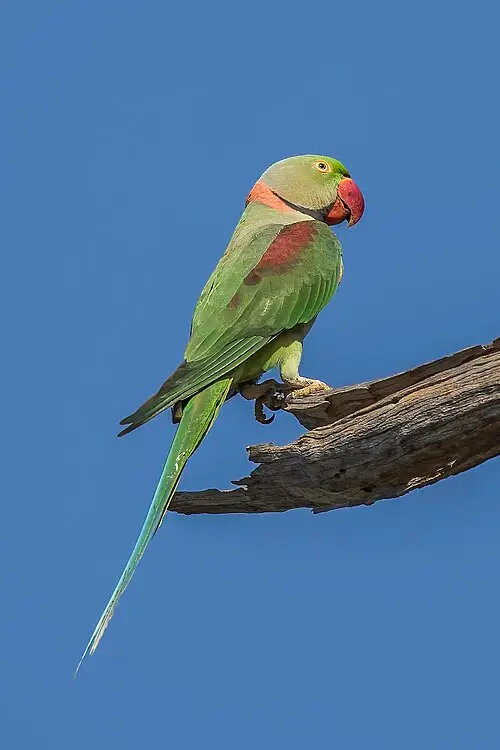
 📸 Photo
Photo: Charles J. Sharp · CC BY-SA 4.0 · Wikimedia Commons Source
Alexandrine Parakeet
Psittacula eupatria (Alexandrine Parakeet · オオホンセイインコ)
💡 Everyday Comparisons for Size, Mass & Speed
- 💡 Its body length of 58 cm is slightly more than half of a 1 m ruler, and its weight of about 260 g is similar to a 250 mL canned drink (about 250 g) (Comparison).
- 💡 When kept as a pet at home, it is recommended to feed it fruits such as apples, pears, oranges, and bananas and vegetables such as carrots, peas, and corn.
- 💡 In the wild, it is known as a pest bird that damages grain and other crops.
Reference standards: coach bus ~12 m, mid-size car ~4.9 m, compact car ~1 t, basketball hoop 3.05 m, credit card 8.56 cm.
Site-computed relative index from recorded values; not a formal scientific metric.
📖 1. Overview
The Alexandrine Parakeet is a large green parakeet living in South and Southeast Asia. It has five subspecies and lives in small flocks in lowland forests, farms, and gardens.
🦴 2. Anatomy & Morphology
Males have a thin black line from the lores to the eye, a thick black stripe across the lower cheek, and a broad pink collar around the hindneck. Its bill is red, its eyes are pale yellow, and there is a dark maroon-red patch on the shoulder, while females are duller and lack the black cheek stripe.
🔍 3. Ecology & Behavior
It eats a variety of wild and cultivated seeds, flower petals and nectar, grain, and fruit, sometimes damaging crops. Living in small flocks, it gathers into large flocks when food is abundant and at communal roosts, nesting in hollows of coconut palms or large trees to lay 2–4 eggs.
🇰🇷 4. Connection to Korea
No direct record connecting this species to Korea has been found.
📚 Sources & References
- • IUCN Red List LC (2025) — https://www.iucnredlist.org/species/22685434/241494588
- • IUCN Red List category LC — latest assessment at iucnredlist.org
- • doi.org — avilist.v2026
- • iucnredlist.org — 241494588
- • wikidata.org — Q753746
- • commons.wikimedia.org — File:Alexandrine parakeet (Psittacula eupatria eupatria) mal
- • parrots.org — alexandrine-parakeet
- • Silhouette: PhyloPic — Robert Cooke · CC0 1.0 (Congeneric silhouette — Psittacula)
Recorded dimensions are widely cited representative estimates from public literature and may vary by study or specimen.