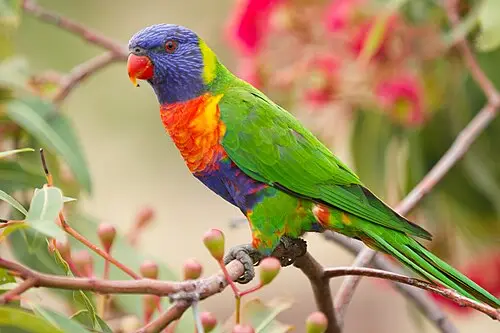
 📸 Photo
Photo: Andrew Mercer (www.baldwhiteguy.co.nz) · CC BY-SA 4.0 · Wikimedia Commons Source
Rainbow Lorikeet
Trichoglossus moluccanus (Rainbow Lorikeet · ゴシキセイガイインコ)
💡 Everyday Comparisons for Size, Mass & Speed
- 💡 Its body length of 32 cm is slightly longer than the long side of an A4 sheet of paper (29.7 cm) (Comparison).
- 💡 Because it thrives in leafy urban areas as well, Perth in Western Australia has a separate population descended from escaped cage birds.
Reference standards: coach bus ~12 m, mid-size car ~4.9 m, compact car ~1 t, basketball hoop 3.05 m, credit card 8.56 cm.
📖 1. Overview
The Rainbow Lorikeet is a colorful parrot living along the northern and eastern coasts of Australia, found widely from rainforests and woodlands to leafy urban areas.
🦴 2. Anatomy & Morphology
It has a striking bright red bill, a purplish-blue head and belly, green wings, tail, and back, and an orange or yellow breast. Males and females look similar.
🔍 3. Ecology & Behavior
It gathers mainly nectar and pollen from flowers on shrubs and tall trees, and also eats fruits, seeds, and insects. It lays its eggs on decayed wood inside hollow eucalyptus branches, where only the female incubates while both parents feed the chicks.
🇰🇷 4. Connection to Korea
No direct record connecting this species to Korea has been found.
📚 Sources & References
- • IUCN Red List category LC — latest assessment at iucnredlist.org
- • doi.org — avilist.v2026
- • iucnredlist.org — 22725334
- • wikidata.org — Q1809222
- • commons.wikimedia.org — File:Rainbow Lorikeet - AndrewMercer IMG08212.jpg
- • australian.museum — rainbow-lorikeet
- • Silhouette: PhyloPic — Hugo Gruson · CC0 1.0 (Related taxon silhouette — Agapornis roseicollis)
Recorded dimensions are widely cited representative estimates from public literature and may vary by study or specimen.