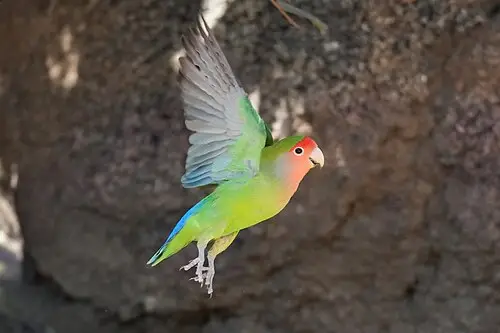
 📸 Photo
Photo: Giles Laurent · CC BY-SA 4.0 · Wikimedia Commons Source
Rosy-faced Lovebird
Agapornis roseicollis (Rosy-faced Lovebird · コザクラインコ)
💡 Everyday Comparisons for Size, Mass & Speed
- 💡 Its body length of 15 cm is similar to one ballpoint pen (about 14 cm), and its flight speed of 58 km/h is close to an urban road speed limit of 60 km/h (Comparison).
- 💡 Kept worldwide as a cage pet, it is popular for its many color mutations and sociable nature.
Reference standards: coach bus ~12 m, mid-size car ~4.9 m, compact car ~1 t, basketball hoop 3.05 m, credit card 8.56 cm.
Site-computed relative index from recorded values; not a formal scientific metric.
📖 1. Overview
The Rosy-faced Lovebird is a small lovebird living in dry areas of southwestern Africa and is considered one of the most beautiful lovebirds.
🦴 2. Anatomy & Morphology
Males have a rosy pink forehead, chin, throat, upper breast, and cheeks, while the rest of the body is bright green. The feet are greenish gray and the bill is horn-colored.
🔍 3. Ecology & Behavior
It plucks seeds such as acacia from plants or picks them up off the ground, husking them quickly with its tongue and bill, and clips only the petals and stamens when eating flowers. It usually travels in flocks of 5–20, drinks water several times a day, and forms pairs very early—even two-month-old birds pair up.
🇰🇷 4. Connection to Korea
No direct record connecting this species to Korea has been found.
📚 Sources & References
- • IUCN Red List LC (2018) — https://www.iucnredlist.org/species/22685342/131916302
- • IUCN Red List category LC — latest assessment at iucnredlist.org
- • doi.org — avilist.v2026
- • iucnredlist.org — 131916302
- • wikidata.org — Q632213
- • commons.wikimedia.org — File:162 Rosy-faced lovebird in flight in Damaraland Photo b
- • animaldiversity.org — Agapornis roseicollis
- • Silhouette: PhyloPic — Hugo Gruson · CC0 1.0
Recorded dimensions are widely cited representative estimates from public literature and may vary by study or specimen.