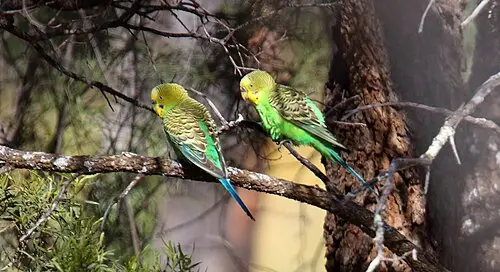
 📸 Photo
Photo: Dominic Sherony · CC BY-SA 2.0 · Wikimedia Commons Source
Budgerigar
Melopsittacus undulatus (Budgerigar · セキセイインコ)
💡 Everyday Comparisons for Size, Mass & Speed
- 💡 Its weight of 30 g is half that of an egg (about 60 g), and its body length of 20 cm is almost equal to the short edge of an A4 sheet (21 cm).
- 💡 With a global population of about 5,000,000, it has been extensively studied, and more is known about its biology than that of any other parrot.
Reference standards: coach bus ~12 m, mid-size car ~4.9 m, compact car ~1 t, basketball hoop 3.05 m, credit card 8.56 cm.
Site-computed relative index from recorded values; not a formal scientific metric.
📖 1. Overview
The Budgerigar is a small parrot native to the dry interior of Australia and the most widely known pet bird in the world. Wild individuals have green bodies and yellow heads.
🦴 2. Anatomy & Morphology
It is small and streamlined with pointed wings and tail. Wild individuals have a yellow forehead and throat, yellow-and-black striping on the head, purple and black cheek markings, and an upper mandible whose tip extends over the lower mandible.
🔍 3. Ecology & Behavior
It picks grass seeds and crop grains off the ground and dehulls them before eating, and stays near water holes because it drinks about 5.5% of its body weight in water daily. It lives in large flocks and breeds after rains when food becomes abundant.
🇰🇷 4. Connection to Korea
No direct record connecting this species to Korea has been found.
📚 Sources & References
- • IUCN Red List LC (2018) — https://www.iucnredlist.org/species/22685223/132056957
- • IUCN Red List category LC — latest assessment at iucnredlist.org
- • doi.org — avilist.v2026
- • iucnredlist.org — 132056957
- • wikidata.org — Q121221
- • animaldiversity.org — Melopsittacus undulatus
- • Silhouette: PhyloPic — Matías Muñoz · CC0 1.0
Recorded dimensions are widely cited representative estimates from public literature and may vary by study or specimen.