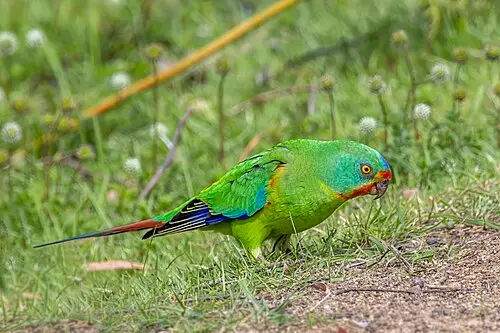
 📸 Photo
Photo: Charles J. Sharp · CC BY-SA 4.0 · Wikimedia Commons Source
Swift Parrot
Lathamus discolor (Swift Parrot · オトメインコ)
💡 Everyday Comparisons for Size, Mass & Speed
- 💡 Its body length of 25 cm is 4–5 cm shorter than the long side of an A4 sheet of paper (29.7 cm) (Comparison).
- 💡 In winter, it also visits flowering fruit trees in urban parks and gardens, spending almost all its time in trees and coming down to the ground only to drink water.
Reference standards: coach bus ~12 m, mid-size car ~4.9 m, compact car ~1 t, basketball hoop 3.05 m, credit card 8.56 cm.
📖 1. Overview
The Swift Parrot is a small parrot living only in southeastern Australia; it breeds only in Tasmania and migrates to the mainland in winter. Its IUCN status is Critically Endangered (CR).
🦴 2. Anatomy & Morphology
Its body is mostly bright green with a dark blue patch on the crown and crimson from the forehead to the throat. Females are slightly duller and have a creamy bar on the underwing.
🔍 3. Ecology & Behavior
It feeds mainly on nectar from flowering eucalyptus trees, and also eats psyllid insects and their sugary coverings (lerp), seeds, and flowers. From September to January, multiple pairs nest close together in tree hollows in Tasmania, and in winter they move to Victoria and New South Wales.
🇰🇷 4. Connection to Korea
No direct record connecting this species to Korea has been found.
📚 Sources & References
- • IUCN Red List CR (2018) — https://www.iucnredlist.org/species/22685219/130886700
- • IUCN Red List category CR — latest assessment at iucnredlist.org
- • doi.org — avilist.v2026
- • iucnredlist.org — 130886700
- • wikidata.org — Q1260561
- • commons.wikimedia.org — File:Swift parrot (Lathamus discolor) South Bruny.jpg
- • australian.museum — swift-parrot
- • Silhouette: PhyloPic — Hugo Gruson · CC0 1.0 (Related taxon silhouette — Agapornis roseicollis)
Recorded dimensions are widely cited representative estimates from public literature and may vary by study or specimen.